Agriculture drone spraying is rapidly transforming the way farmers manage their fields delivering inputs with a precision, speed, and efficiency that traditional methods simply cannot match. As global food demand is expected to surge significantly by 2050, modern farming must evolve. Unmanned Aerial Vehicles (UAVs) are emerging as one of the most powerful tools in this transformation, enabling farmers to spray pesticides, herbicides, fertilizers, and other crop treatments with pinpoint accuracy while dramatically reducing costs, labor, and environmental impact.
What Is Agriculture Drone Spraying?
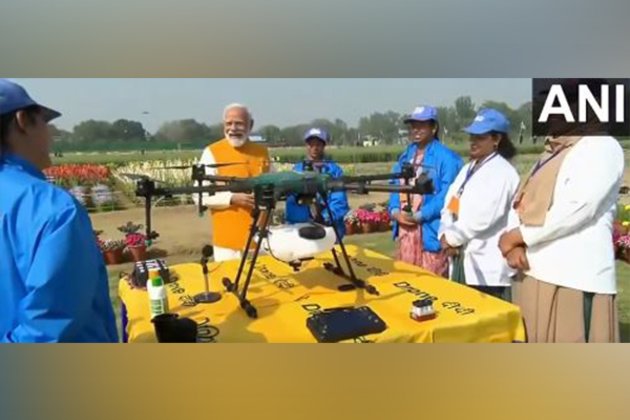
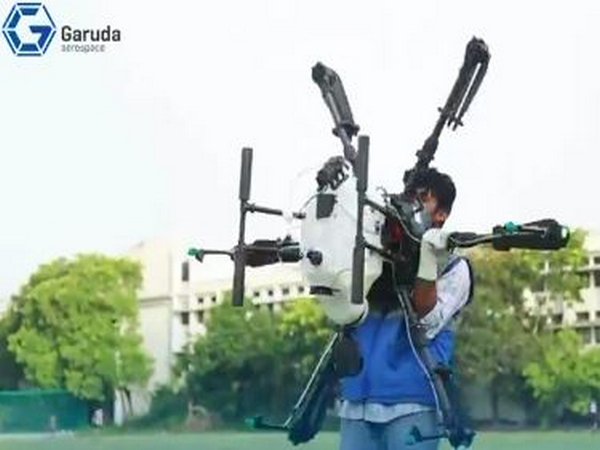
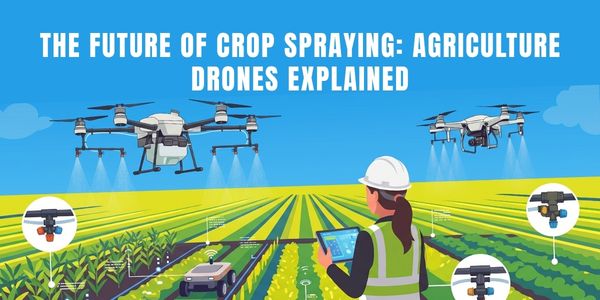
Agriculture drone spraying refers to the use of UAVs equipped with liquid tanks and precision nozzles to apply crop inputs from the air. These drones are programmed with GPS-guided flight paths, allowing them to cover fields systematically while maintaining a consistent altitude and spray width.
Modern agricultural spraying drones integrate terrain-following radar, LIDAR sensors, and high-precision GNSS systems that automatically adjust flight altitude to match crop canopy height. This means even undulating or irregularly shaped fields receive uniform, consistent coverage something traditional boom sprayers or backpack sprayers cannot reliably achieve.
The crop spraying drone market reflects this momentum: estimated at around $2.47 billion in 2024, it is projected to reach $10.86 billion by 2029, driven by adoption of precision agriculture solutions, rising labor costs, and growing awareness of sustainable farming practices.
How Agriculture Drone Spraying Works
The process begins with field mapping. Before a drone takes flight, operators use mapping software to plan the flight path, accounting for field boundaries, obstacles, and crop type. The drone is then loaded with the appropriate chemical or fertilizer solution and launched on its pre-programmed route.
Flying at low altitudes typically 1.5 to 5 meters above the crop canopy the drone applies liquid through precision nozzles mounted on its arms. Onboard sensors monitor real-time conditions and can dynamically adjust application rates based on crop density, wind speed, or other environmental variables.
After each mission, the data collected supports performance analysis: coverage maps, spray logs, and flight records provide farmers with digital proof of what was applied, where, and how uniformly. This data layer is increasingly being integrated with broader crop health monitoring platforms, creating a feedback loop that continuously improves farm management decisions.
Key Benefits of Agriculture Drone Spraying
1. Precision and Reduced Chemical Use
One of the most significant advantages of agriculture drone spraying is targeted application. Unlike traditional sprayers that apply inputs broadly across an entire field, drones can be directed toward specific zones for example, areas with identified pest pressure or nutrient deficiencies. This targeted approach can reduce pesticide usage by up to 30% and water consumption by up to 90% compared to conventional methods.
2. Speed and Efficiency
Agricultural spraying drones can cover 4 to 20 hectares per hour, making them approximately 40 times faster than manual backpack sprayers. For time-sensitive applications such as fungicide treatments during early disease onset this speed can be the difference between saving a crop and losing it.
3. No Soil Compaction
Heavy tractors compact soil over time, degrading its structure and reducing crop yields. Because drones operate aerially, they leave no tire tracks, preserve soil health, and can even access fields that are too wet or soft for ground-based machinery.
4. Access to Difficult Terrain
Steep slopes, flooded areas, and dense orchards have historically been difficult or dangerous to spray manually or with large equipment. Drones navigate these environments with ease. This is particularly relevant for crops like vineyards, orchards, and hilly rice paddies, where traditional methods are hazardous.
5. Operator Safety
Prolonged exposure to pesticides and herbicides poses serious health risks for farm workers. With drone spraying, operators control missions remotely, minimizing direct contact with chemicals. This is a major advantage for farms that regularly apply crop protection products.
6. Lower Operational Costs
Although the upfront investment in drone technology can be significant, the long-term savings are compelling. Reduced labor requirements, lower chemical usage, and faster operations translate into meaningful cost reductions especially for farms larger than approximately 2.27 hectares, where drone adoption is generally cost-effective.
Agriculture Drone Spraying and Fertilizer Application
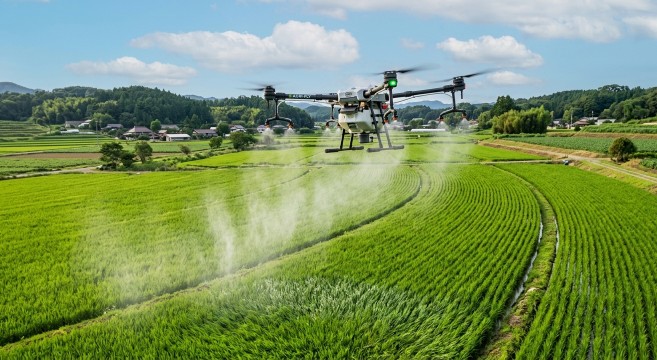
Beyond crop protection chemicals, drones are proving highly effective for fertilizer spraying. Liquid fertilizers particularly water-soluble, ultra-low volume (ULV) formulations are well suited to drone application. Because drone tanks typically hold between 5 and 50 liters, choosing highly concentrated fertilizer products ensures maximum area coverage per flight.
Key considerations when selecting fertilizers for drone application include:
- Nutrient profile matched to crop requirements (including micronutrients like boron, zinc, and manganese)
- Water solubility drones are better suited to liquid rather than granular products
- Low salt index to prevent leaf burn during foliar application
- High concentration to maximize coverage efficiency per tank load
Drone-applied foliar fertilizers can be applied at just 20–50 liters per hectare, compared to 200–300 liters per hectare with conventional sprayers a dramatic reduction in both water use and application time.
For farms exploring how these nutrient inputs integrate with broader agronomic planning, soil mapping and nutrient analysis using drone imagery can identify variability across fields and guide variable-rate fertilizer programs.
Beyond Spraying: A Complete Aerial Farm Intelligence System
Agriculture drone spraying is just one part of what modern drone platforms can offer. Today's precision agriculture solutions combine multiple functions into a unified aerial system:
Crop Health Monitoring
Using multispectral cameras and NDVI imaging, drones detect early signs of water stress, nutrient deficiency, and disease — often weeks before they become visible to the naked eye. This enables farmers to take preventive action and minimize losses.
Disease and Pest Detection
Disease and pest detection using high-resolution RGB and thermal imaging allows for precise identification of infection zones. Rather than applying treatments across an entire field, farmers can target only affected areas — reducing chemical use and crop stress.
Seed Spreading
Beyond liquid applications, some drone platforms support seed spreading — distributing seed balls or coated seeds uniformly across a field or even into inaccessible terrain. This is particularly valuable for reforestation projects and direct seeding of paddy fields.
Pollination Assistance
Drones are increasingly being used for pollination assistance in high-value crops such as date palms, walnuts, and greenhouse orchards where natural pollinators may be insufficient or inaccessible.
What to Look for in an Agricultural Spraying Drone
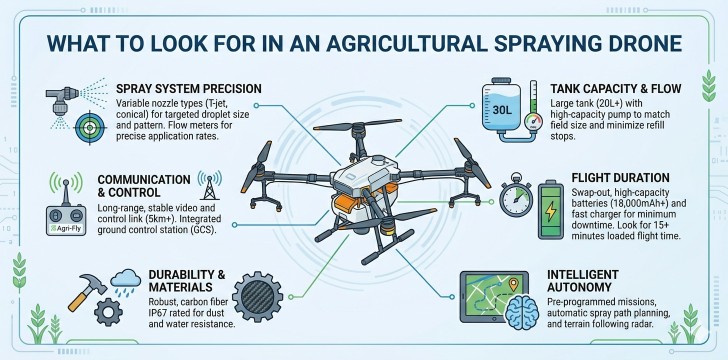
Selecting the right drone for your farm is critical. Here are the most important factors to evaluate:
- Tank capacity and flow rate — directly affects area coverage per flight and refill frequency
- Flight time — most spraying drones operate for 10–25 minutes per charge; consider battery swap systems for large fields
- Spray width — wider spray booms increase efficiency on open fields
- Nozzle type and droplet size — finer droplets improve canopy penetration; coarser droplets reduce drift
- Terrain-following capability — essential for hilly or uneven fields
- GPS and autonomy — pre-programmed flight paths with obstacle avoidance improve safety and consistency
- Regulatory compliance — in India, all agricultural drones must comply with DGCA (Directorate General of Civil Aviation) guidelines
For farms considering drone adoption, working with a certified training and support ecosystem ensures not just equipment selection, but safe, compliant, and effective operations. DGCA-approved drone pilot training programs are available for those looking to build in-house UAV capability.
The Future of Agriculture Drone Spraying
The next decade will see agriculture drone spraying evolve from a standalone operation into a fully integrated component of smart farming systems. Several emerging trends will shape this evolution:
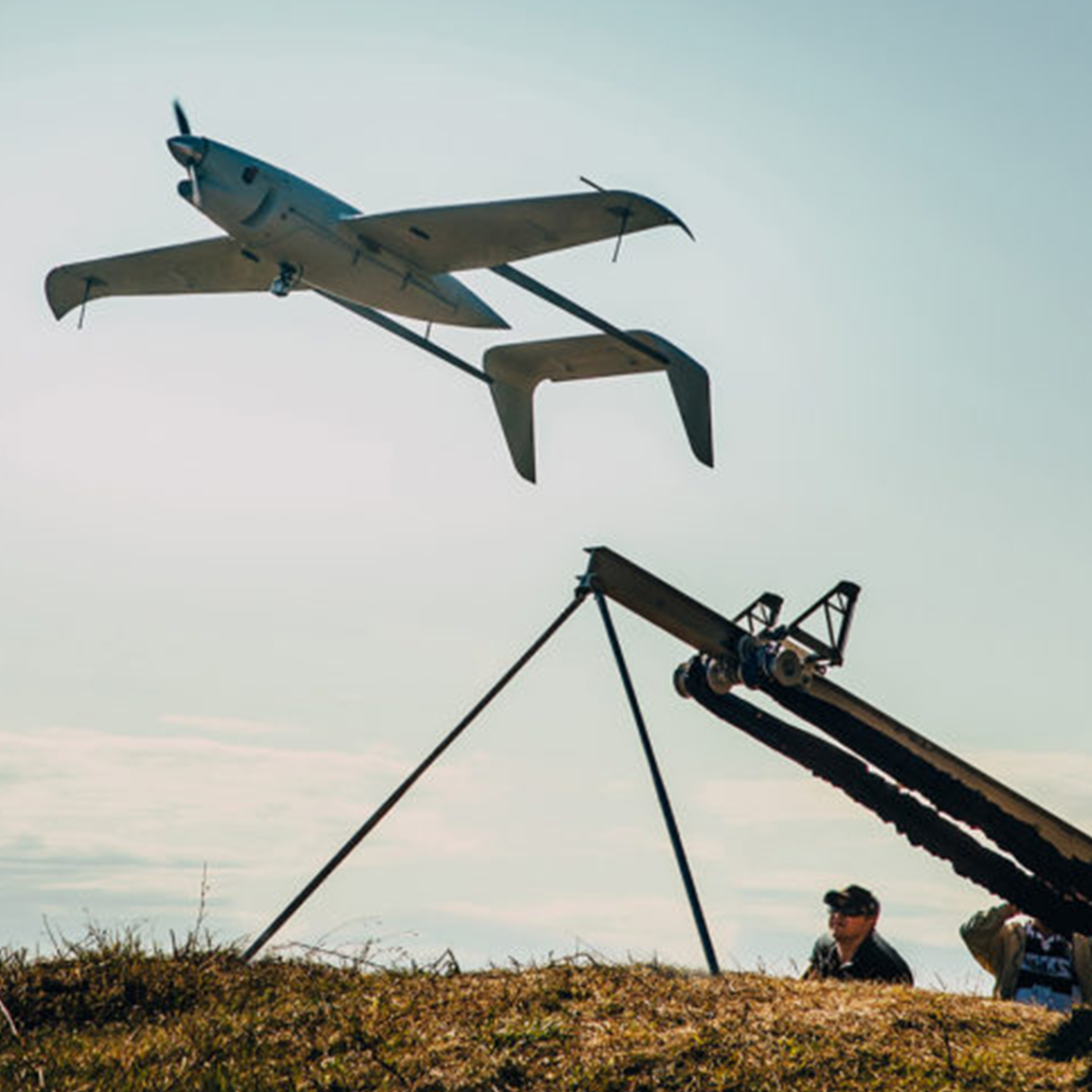
Swarm technology — fleets of coordinated drones working in parallel will enable large-scale operations that rival fixed-wing aerial spraying in coverage speed while retaining the precision of UAVs.
AI-driven adaptive spraying — machine learning models will analyze real-time imagery to automatically adjust spray rates, target only stressed crop zones, and predict optimal application windows based on weather data.
Extended flight with hydrogen fuel cells — current battery limitations restrict flight times; hydrogen fuel cells promise significantly longer operational windows and higher payload capacities.
Variable Rate Spraying (VRS) — drones will dynamically adjust spray density across a field based on pre-loaded soil maps and crop variability data, ensuring inputs are applied only where and at the rate they are needed.
IoT integration — real-time soil moisture sensors, weather stations, and farm management platforms will feed directly into drone flight control systems, enabling fully automated, data-driven spray events.
Final Thoughts
Agriculture drone spraying is no longer a futuristic concept — it is a practical, proven technology delivering measurable benefits to farmers across India and the world. From faster application and reduced chemical use to improved crop health and lower labor demands, the case for drone adoption in modern farming is compelling and only growing stronger.
As the technology matures and regulatory frameworks continue to develop, the integration of drone spraying with broader precision agriculture solutions — including crop monitoring, soil analysis, pest detection, and AI-based farm intelligence — will create a new standard for how farms are managed.
The question for today's farmer is not whether to adopt drone technology, but how soon and how comprehensively to integrate it into their operations.