
Spotlight | Oct 24, 2026 | 2 Min

Spotlight | Oct 24, 2026 | 2 Min
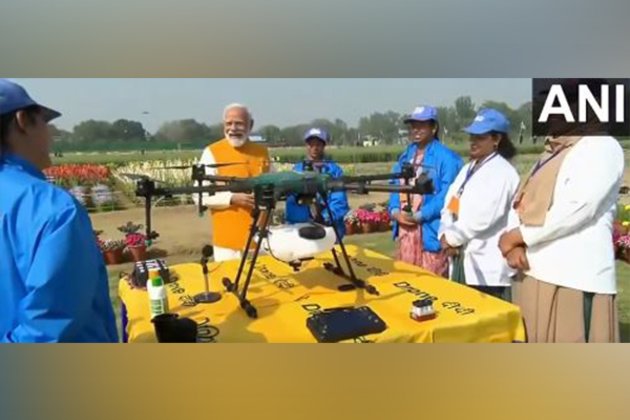
Prime Minister Narendra Modi on Monday handed over 1000 drones to 1,000 Namo Drone Didis across 10 locations across the country and disbursed bank loans to Self Help Groups (SHGs) in the Sashakt Nari - Viksit Bharat programme at Indian Agricultural Research Institute, Pusa in New Delhi.The PM also interacted with Lakhpati Didis while they shared their stories of resilience, determination and success.Speaking at Sashakt Nari - Viksit Bharat programme, the Prime Minister said, "Today's event is a historic one. In the coming years, drone technology is going to expand in the country. Innumerable avenues are going to open up for the 'Namo Drone Didis' in the country. In the last 10 years, the way Self Help Groups have expanded in the country is a matter of study. SHGs in India have created a new history in the area of women empowerment.""Drones will act as a capable channel/medium for delivery of small items like milk and groceries. Drones will also play a pivotal role in the delivery of medicines and medical samples. Namo drone didi Yojana is enabling women to become drone pilots, opening up countless opportunities for them," the PM added.Some of the drones distributed by the PM were Kisan drones manufactured by Garuda Aerospace."It is extremely validating to see our Honorable Prime Minister Narendra Modiji distributing 1000 drones to Drone Didis representing Women Self Help Groups from 22 states. Our goal is to ensure Women Entrepreneurs in rural India and Indian farmers have access to affordable Precision Agri Drone Technology and create massive employment for youth in our country" Agnishwar Jayaprakash, Founder and CEO of Garuda Aerospace said.The NaMo Drone Didi and Lakhpati Didi initiatives are an integral part of the Prime Minister's vision to promote economic empowerment and financial autonomy among women, especially in rural areas.During the programme, the Prime Minister felicitated Lakhpati Didis who have achieved success with the support of Deendayal Antyodaya Yojana - National Rural Livelihood Mission and are supporting and motivating other Self Help Group SHG members for their upliftment.The NaMo Drone Didi Initiative aims to empower rural women by training them to become drone pilots for agricultural purposes.The initiative aims to equip 15,000 women-led Self-Help Groups (SHGs) with agricultural drones to assist in tasks such as crop monitoring, spraying fertilisers and sowing seeds. (ANI)Source: https://www.bignewsnetwork.com/news/274152804/pm-modi-applauds-spirit-of-india-lakhpati-didis-distributed-1000-kisan-drones-to-1000-namo-drone-didis
Mar 25, 2025 | 2 min read
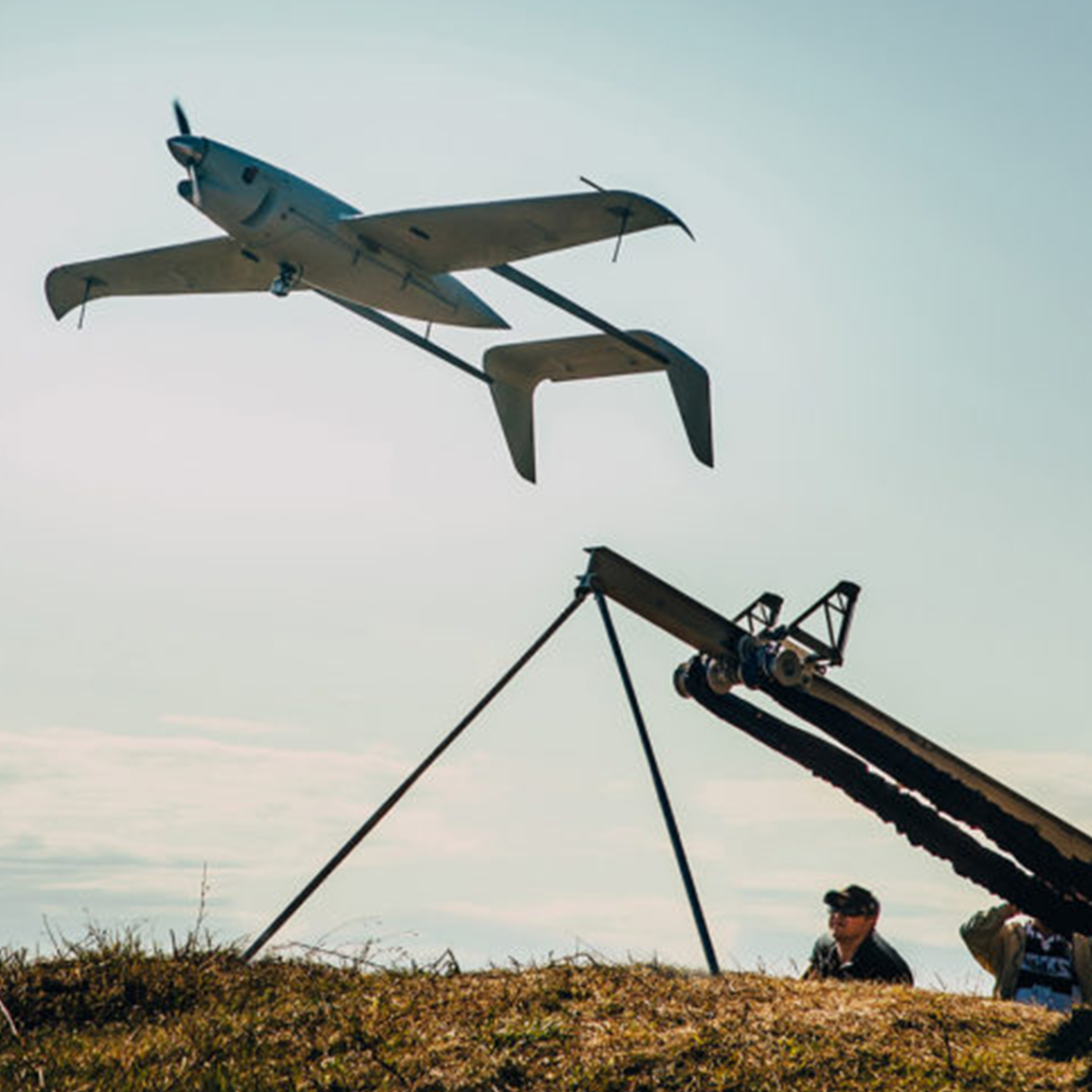
Drone manufacturer Garuda Aerospace, backed by Cricket legend Mahendra Singh Dhoni, has launched a border patrol surveillance drone, Trishul, the company said on Friday. The surveillance drone can be used for monitoring people movement, natural calamities and assessing traffic, among other things.Equipped with a variety of sensors including high-definition cameras, infra-red and radar, Trishul can provide data regarding speed and safety threats, Garuda Aerospace said in a release here."The launch of Trishul exemplifies our commitment to building a sustainable drone ecosystem, with products and services that set new benchmarks. Trishul makes way for uninterrupted access to critical real-time information and enables prompt decision-making," Garuda Aerospace Founder-CEO Agnishwar Jayaprakash said.Source: https://www.ndtvprofit.com/business/garuda-aerospace-unveils-border-patrol-surveillance-drone
Mar 25, 2025 | 2 min read

Filter By
Clear all
Category
View Less
Type
View Less
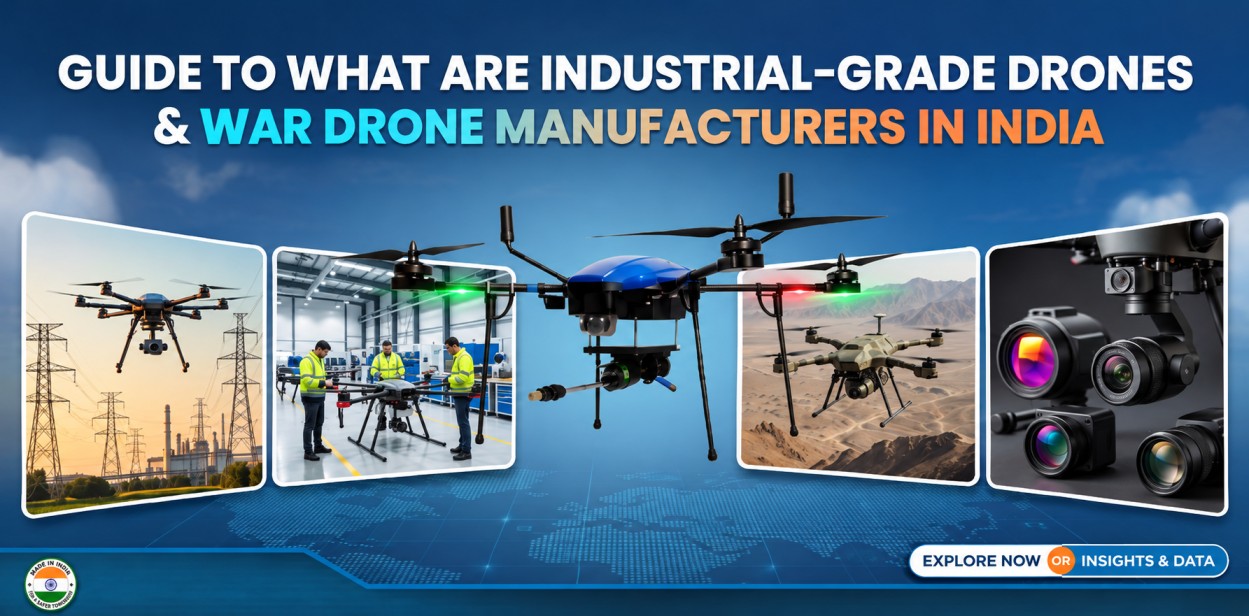
What are industrial-grade drones, and why are Indian industries and defense forces investing in them so quickly? They are rugged unmanned aerial vehicles built to carry heavy sensors, fly in tough weather, and deliver reliable data every day. India's drone sector is growing fast because of supportive policy, rising demand from farming and infrastructure, and strong defense needs. This guide covers the basics, the uses, and the manufacturers behind them.1. What Are Industrial-Grade Drones?Industrial-grade drones are unmanned aerial vehicles engineered for demanding commercial, infrastructure, and strategic work rather than hobby flying. They combine a strong airframe, dependable propulsion, professional sensors, and software that turns flight data into decisions. These systems are built to fly the same mission repeatedly without losing accuracy.Most industrial-grade drones carry payloads such as LiDAR scanners, thermal cameras, multispectral sensors, and high-resolution mapping cameras. They also support RTK positioning for centimeter-level accuracy and encrypted datalinks for secure control. This is why utilities, miners, farmers, and security teams now treat them as core equipment.Core traits include:High payload capacity for heavy sensorsLong flight endurance for large survey areasTolerance to wind, rain, and temperature extremesModular payload bays for fast sensor swapsRedundant motors and flight controllers for safety2. How Do Industrial-Grade Drones Differ from Consumer Drones?Industrial-grade drones differ from consumer drones mainly in payload, durability, sensor quality, and autonomy. A consumer model is small and made for photography or recreation. An industrial platform is larger, sturdier, and designed for daily professional use in harsh conditions.FeatureConsumer DroneIndustrial-Grade DronePayloadFixed cameraSwappable LiDAR, thermal, multispectralDurabilityLight plastic bodyReinforced, weather-resistant frameFlight time20 to 30 minutes40 to 250 minutes, depending on power typePositioningStandard GPSRTK or PPK for survey-grade accuracySafetyBasic failsafesRedundant propulsion and encrypted linksUse caseHobby and contentInspection, mapping, security, agriculture3. Where Are Industrial-Grade Drones Used in India?Industrial-grade drones are used wherever data must be collected safely, quickly, and accurately. They replace slow manual checks, reduce risk to workers, and give teams a clear aerial view of large or dangerous sites. Here are the major sectors.3.1 AgricultureIn farming, drones scan fields for crop stress, pests, and nutrient gaps. Precision agriculture drones also handle targeted spraying, which cuts chemical use and labor costs. Farmers gain faster decisions and better yield forecasts across large holdings.3.2 Energy and InfrastructurePower lines, solar farms, wind turbines, bridges, and pipelines need frequent checks. Drones with thermal and zoom cameras spot overheating, cracks, and corrosion without shutdowns or scaffolding. This improves safety and supports predictive maintenance.3.3 Safety and SecurityDrones give security teams live aerial views for perimeter patrol, crowd monitoring, and disaster response. Many organizations adopt safety and security solutions built on drone data to spot threats earlier and respond faster.3.4 Mining and ConstructionDrones measure stockpiles, track earthwork progress, and compare as-built structures against design models. They create 3D maps in hours instead of days. This lowers rework and keeps projects on schedule.4. How to Choose What Industrial-Grade Drones Fit Your MissionThe right industrial-grade drone is the one that matches your payload, endurance, and weather needs. Follow these five steps to make a confident choice.Step 1: Define the mission. Write down what you need to capture, such as thermal faults, terrain models, or crop health. The mission decides the sensor, and the sensor decides the aircraft.Step 2: Check payload capacity. Add up the weight of your sensors and accessories. Choose a platform with a comfortable margin above that number.Step 3: Match endurance to area. Large corridors and farms favor long-endurance or hybrid power. Small detailed inspections suit compact multirotors.Step 4: Verify weather tolerance. Ask about wind limits, rain rating, and operating temperatures. Reliability on a bad day matters more than performance on a good one.Step 5: Consider the service model. If you do not want to own a fleet, Drone-as-a-Service lets you hire pilots, aircraft, and data processing for each project.5. Who Are War Drone Manufacturers in India?War drone manufacturers in India are defense-focused companies that design unmanned aircraft for surveillance, reconnaissance, logistics, and tactical support. The term is commonly used online, but the industry usually calls them defense or military drone manufacturers. They work with the armed forces, research bodies, and private partners.The Indian defense drone ecosystem has grown quickly through government programs that encourage local production. Companies now build indigenous airframes, payloads, and communication systems rather than relying only on imports. A growing range of defense drones now supports border monitoring, situational awareness, and field logistics.Typical roles of defense drones:Border and coastal surveillanceReconnaissance in rough terrainLogistics and supply to remote postsDamage assessment after incidentsTraining and simulation support6. What Standards Do Defense Drone Manufacturers Follow?Defense drone manufacturers follow stricter standards than commercial builders because missions are higher risk. Platforms must handle shocks, extreme temperatures, and secure communication. Quality checks, documented testing, and traceable components are part of the process.RequirementWhy It MattersRugged buildSurvives vibration, dust, and moistureEncrypted datalinkProtects control and video from interceptionLong enduranceSupports extended patrol missionsRedundancyKeeps the aircraft flying after a failureIndigenous contentAligns with national self-reliance goalsTest recordsProves reliability before deployment7. What Rules and Skills Do You Need to Operate Industrial-Grade Drones?Operating industrial-grade drones in India requires compliance with DGCA rules and a trained, certified pilot. Heavier drones and special sensors usually fall under stricter categories. Beyond visual line of sight operations need extra approvals and risk planning.Skilled operators are as important as the aircraft. A structured drone pilot training program covers airspace rules, weather reading, flight planning, and emergency handling. Well-trained pilots protect assets, keep data consistent, and help organizations stay compliant as regulations evolve.8. ConclusionUnderstanding what industrial-grade drones are helps you see why they have become essential across Indian industry and defense. Their strength comes from payload, endurance, reliability, and data quality. Choose by mission, verify weather limits, and train your pilots well. As manufacturers keep innovating, these platforms will take on even more complex tasks.Which sector are you planning to use drones in: farming, infrastructure, or security? Tell me, and I can tailor the next article.9. FAQs: What Are Industrial-Grade Drones?What are industrial-grade drones in simple words? They are tough, high-capacity drones built for professional work such as inspection, mapping, farming, and security.Are industrial-grade drones the same as defense drones? No. Many share similar technology, but defense drones add secure communication and mission-specific hardening.Do I need a license to fly them in India? Yes. Most commercial operations need a certified remote pilot and compliance with DGCA regulations.How much payload can they carry? It varies widely, from a few kilograms to nearly 20 kg or more on heavy-lift models.
Oct 24, 2026 | 2 min read
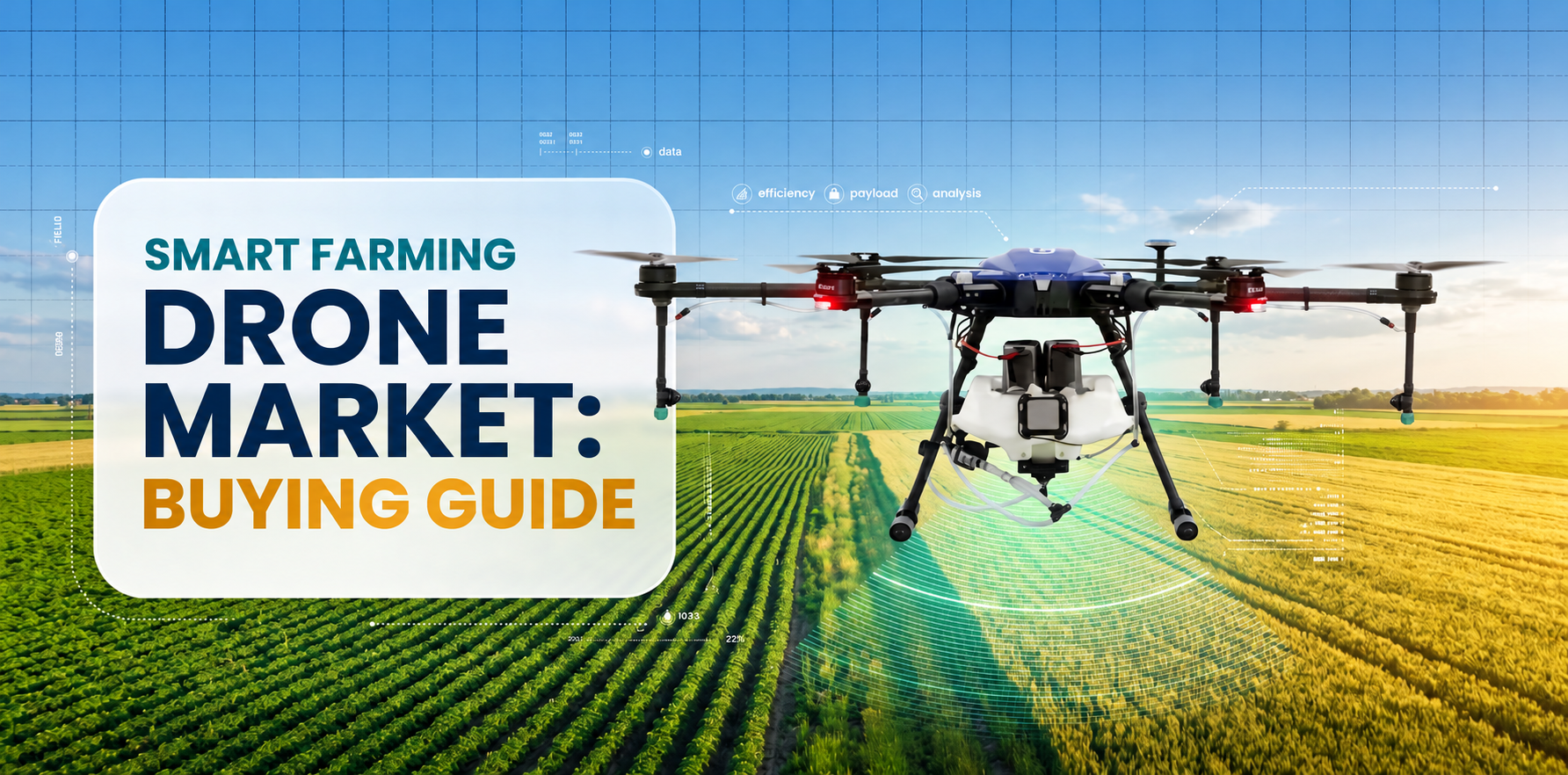
The smart farming drone market is growing quickly because farmers need faster, cheaper and more accurate ways to manage crops. Research firms project the global agriculture drone market to reach about USD 21.59 billion by 2033, growing at a CAGR of 26.5% from 2026. That growth means more models, more software and more service options than ever before. For a buyer, more choice can feel confusing. This guide breaks the decision into clear numbered steps so you can match a drone to your land, your crops and your budget.1. What Is the Smart Farming Drone Market and Why Does It Matter?The smart farming drone market includes drones, sensors, software and services that help growers collect field data and act on it. Hardware such as frames, cameras, flight controllers and sensors still holds the largest revenue share. Software and managed services are catching up fast as farmers want insights, not just images. Rotary wing drones lead the market with roughly 62% of revenue, because they hover, turn sharply and work well on small or uneven plots.Drones matter because they replace slow manual checks with quick aerial views. A single flight can reveal water stress, nutrient gaps, weed patches or pest outbreaks before they spread. Some reports suggest precision farming systems can lift yields by up to 5%, which is a big gain in a low margin business. North America holds the largest regional share at about 33.5%, while Asia Pacific countries such as India, China and South Korea are adopting spray and mapping drones at speed.2. How Do You Define Your Farm Goals Before Entering the Smart Farming Drone Market?Start by writing down the one or two jobs you want a drone to do, because the smart farming drone market offers tools built for very different tasks. A drone for scouting is not the same as a drone for spraying. Buying a general purpose machine without a clear goal often leads to wasted money and unused equipment. Clear goals also help you ask better questions when you speak to suppliers.Ask yourself these questions before you shop:How many acres or hectares do I need to cover each week?Is my main need crop scouting, spraying, mapping, livestock checks or security?What crops do I grow, and are they in rows, orchards or mixed plots?Is the terrain flat, sloped, wet or hard to reach?Who will fly the drone, and how much training do they have?Your answers become your shortlist filter. A grower with 20 acres of vegetables has very different needs from a sugarcane estate or a large cattle property.3. Which Drone Types Are Available in the Smart Farming Drone Market?There are two main designs in the smart farming drone market: fixed wing and rotary wing. Fixed wing drones fly longer and cover large areas in one battery cycle, which suits broadacre mapping. Rotary wing drones, including multi rotor models, hover in place and carry heavier payloads, which suits spraying and close inspection. Hybrid vertical take off and landing models combine both strengths but usually cost more.Drone TypeBest ForStrengthsLimitsFixed wingLarge field mappingLong flight time, wide coverageNeeds space to launch and landMulti rotorScouting, spraying, small farmsHovers, flexible, easy to flyShorter battery lifeHybrid VTOLMixed or remote farmsRange plus hover abilityHigher price, more complexWhich of these matches your land? If you farm in small, irregular plots, multi rotor is usually the safest start. If you manage thousands of acres, a fixed wing or hybrid model may save time.4. How Do You Choose Sensors and Payloads for Your Farm?Choose the sensor based on the problem you want to solve, because the sensor decides what your drone can actually see. Standard RGB cameras show colour, plant density and stand gaps. Multispectral sensors measure light bands that reveal plant health through indices such as NDVI. Thermal cameras detect water stress and help find livestock. LiDAR builds detailed elevation maps that show drainage patterns and wet or dry spots.Drone imagery is more useful when it connects to your records. Many growers upload flight data into farm management software so they can view field health next to spray logs and harvest results. Image processing tools can also turn raw photos into heat maps, vegetation indices and 3D models. Ask every supplier whether their drone works with common mapping and analytics platforms before you commit.5. Should You Buy Spray Drones in the Smart Farming Drone Market?Spray drones are one of the fastest growing segments of the smart farming drone market, but only buy one if your rules and crops allow it. Drones can reach steep, wet or flooded areas without putting workers at risk. They also deliver fine, targeted applications that can cut chemical use and reduce soil compaction. In South Korea, drones already handle around 30% of agricultural spraying.Modern precision spraying systems use onboard sensors, automatic height control and droplet size management for accurate coverage. However, regulations vary widely by country, and some regions still restrict spray drones until spray drift is better understood. Check your local licensing rules first. Also consider the load. Spray work needs larger batteries, tanks and a trained operator, so the total cost is higher than for a scouting drone.6. Buy, Lease or Hire: Which Model Fits the Smart Farming Drone Market?You can enter the smart farming drone market in three ways: buy a drone, lease one, or hire a service provider. Buying gives full control and the lowest long term cost if you fly often. Leasing lowers the upfront spend and often includes maintenance. Hiring a drone-as-a-service provider means you pay only for completed jobs, such as a mapping flight or a spray pass, and skip equipment and training costs.OptionUpfront CostControlBest ForBuyHighFullLarge or busy farmsLeaseMediumSharedSeasonal needsHire a serviceLowLimitedSmall farms, first time usersExperts often suggest starting small and adding drone data to your routine slowly. Hiring a service for one season is a low risk way to test the value before you invest in your own aircraft.7. What Rules and Training Do You Need in the Smart Farming Drone Market?Every drone buyer must follow local aviation rules, and many countries also require special licences for chemical spraying. In most regions you need to register the drone, keep the aircraft within visual line of sight and avoid restricted zones. Some places require a certified remote pilot, especially for heavier drones or spray work. Ignoring these rules can lead to fines, grounded equipment or insurance problems.Training protects your investment as much as it protects people. A trained pilot crashes less, plans better flights and collects cleaner data. In India, for example, operators look for DGCA certified drone pilot training from approved institutions. Many farmers also prefer a recognised remote pilot training organisation that combines classroom lessons, simulators and real flight practice. Budget for training in your first year, not as an afterthought.8. How Much Does It Cost to Enter the Smart Farming Drone Market?Costs in the smart farming drone market range from a few thousand dollars for a basic scouting drone to tens of thousands for a large spray platform. The drone itself is only part of the bill. Use the checklist below to build a realistic budget:Drone and extra batteriesSensors, cameras or spray tanksSoftware subscriptions and data storagePilot training and licence feesInsurance and registrationMaintenance, spare parts and charging equipmentReturn on investment comes from saved labour, lower chemical use, fewer crop losses and faster decisions. Estimate these savings honestly. If a drone will fly only a few hours a year, a service provider may cost less than ownership.9. Your Step by Step Buying Process for the Smart Farming Drone MarketFollow these seven steps to buy with confidence in the smart farming drone market:Step 1: Write down your top two farm tasks and your total acreage.Step 2: Pick a drone type, fixed wing, multi rotor or hybrid, that fits your terrain.Step 3: Choose the sensor or sprayer that solves your main problem.Step 4: Check local aviation, spraying and data rules.Step 5: Compare buying, leasing and service options using a full cost list.Step 6: Request a live demo and ask about software, support and warranty.Step 7: Plan pilot training and start with a small pilot field.Where can you see the current range of options? Reviewing a supplier catalogue of agricultural drone products helps you compare payloads, flight times and prices side by side before you decide. Always ask for real field results, not just brochure claims.10. What Does the Future Hold for the Smart Farming Drone Market?The smart farming drone market is moving toward more automation, better artificial intelligence and tighter links with other farm technology. Machine learning will soon identify weeds and pests automatically and suggest the right treatment. Drones will fly more independently, needing little human input. Researchers are also testing pollination drones and microwave soil moisture sensing for smarter irrigation, which matters as drought conditions increase.One current gap is crop variety. Today's drone software works best on large uniform fields such as corn and still struggles with mixed plantings and less common crops. As training data improves, smaller farmers in developing regions will benefit most. Buying a drone with open software and upgradeable sensors helps you keep up with these changes without replacing your whole system.Final ThoughtsThe smart farming drone market offers real benefits, but the best purchase is the one that matches your goals, land and skills. Define your tasks, choose the right drone type and sensor, confirm the rules, count every cost and train your pilot. Start small, measure results and scale up when the numbers prove the value. What is the first job you want a drone to take off your plate this season?
Oct 21, 2026 | 2 min read
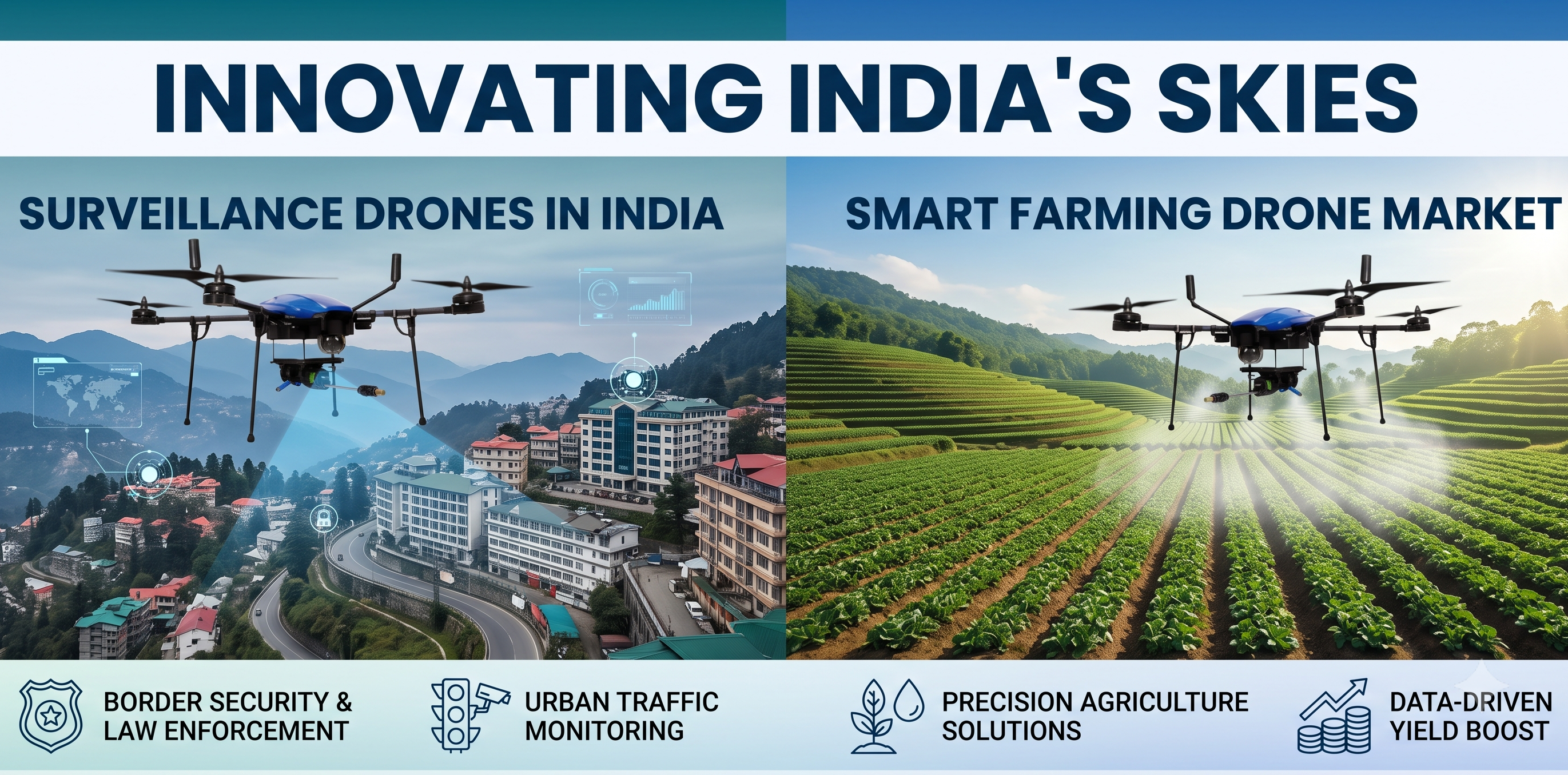
Surveillance drones in India have moved from a niche defense tool to a mainstream technology used by police, industries, and farmers. Falling hardware costs, clearer regulations, and better cameras have pushed adoption across the country. At the same time, the smart farming drone market is growing fast as growers look to cut input costs and raise yields. Both segments rely on the same core idea: a flying platform that collects accurate data from above. This article explains how each one works, where they overlap, and how to choose the right option.1. What Are Surveillance Drones in India and Why Do They Matter?Surveillance drones in India are unmanned aircraft fitted with cameras and sensors to monitor people, places, and assets from the air. They matter because they cover large areas faster, cheaper, and more safely than foot patrols or vehicles. A single flight can scan a border stretch, a factory perimeter, or a festival crowd within minutes. Operators receive live video and can act on what they see right away.Demand keeps rising because the country has long borders, dense cities, and large industrial sites that are hard to watch around the clock. Many organizations now use drone-based security and surveillance services instead of buying and maintaining hardware themselves. This lowers the entry barrier for small businesses and local authorities.2. How Do Surveillance Drones in India Work? A Step-by-Step ViewSurveillance drones in India work through a five-step cycle of planning, flying, capturing, transmitting, and analyzing data.2.1 Step 1: Plan the MissionOperators define the area, altitude, flight time, and weather limits. They also check airspace permissions before takeoff.2.2 Step 2: Launch and NavigateThe drone follows GPS waypoints on its own or flies under manual control. Obstacle sensors help it avoid poles, wires, and buildings.2.3 Step 3: Capture the DataHigh-resolution, zoom, and thermal cameras record what is happening below. Thermal sensors are especially useful at night or in smoke.2.4 Step 4: Transmit the Live FeedAn encrypted link sends video to a control room or a handheld screen. This keeps the information secure and the response fast.2.5 Step 5: Analyze and ReportSoftware flags people, vehicles, or unusual activity. Teams then save footage, log the flight, and share findings with decision makers.3. Where Are Surveillance Drones in India Used Today?Surveillance drones in India are used mainly for border monitoring, policing, industrial safety, disaster response, and agriculture. Each sector values a slightly different mix of range, endurance, and sensor quality. The table below shows the most common uses.SectorTypical UseKey BenefitBorder and defensePerimeter patrols, night monitoringWide coverage with fewer personnelPolicing and crowd controlEvent and traffic monitoringReal-time situational awarenessIndustrial sitesPerimeter checks, asset inspectionFewer manual risksDisaster responseSearch and damage assessmentFaster decisionsAgricultureCrop and field monitoringEarly detection of stressArmed forces rely on purpose-built defense drones for reconnaissance in rugged terrain, where long endurance and secure links matter most. Factories, mines, and power utilities use industrial drones to inspect tall structures and monitor large premises safely.Features buyers usually look for:High-resolution zoom camera for clear identificationThermal imaging for low-light operationsFlight time of 30 minutes or more for multirotor modelsEncrypted data link to protect live videoObstacle avoidance for safer flights in cities4. What Is the Smart Farming Drone Market in India?The smart farming drone market in India is a fast-growing segment driven by labor shortages, rising input costs, and strong government support. Globally, the agriculture drone market was valued at about $4.98 billion in 2023 and is projected to reach roughly $23.78 billion by 2032, a growth rate of about 18.5% a year, according to Fortune Business Insights. India is expected to be a major contributor because of its large farming population and small landholdings.Modern precision agriculture drones carry spray tanks and sensors that treat only the areas that need attention. This saves water, pesticides, and time compared with manual spraying. Farmers also gain field maps that show exactly where crops are struggling.What is driving growth:Shortage of farm labor during peak seasonsGovernment subsidies and schemes that promote drone adoptionSavings on water and chemicals through targeted sprayingGrowing awareness among younger, tech-friendly farmers5. How Do Surveillance Drones in India Support Smart Farming?Surveillance drones in India support smart farming by giving farmers a live, accurate view of their fields without walking every acre. The same camera and sensor technology used for security also works well for crop monitoring. Here is a simple flow farmers can follow.Map the field. Fly a grid pattern to create a clear picture of boundaries and terrain.Monitor crop health. Multispectral or thermal cameras reveal stress before the human eye can see it.Detect problems early. Spot pest patches, irrigation leaks, and uneven growth in time to react.Act with precision. Spray or treat only the affected zones to cut waste.Protect the farm. Patrol boundaries to deter theft and track wildlife movement at night.Farmers who do not want to buy equipment can choose Drone-as-a-Service and use drones only when needed. This model keeps costs predictable and removes the burden of maintenance and pilot training.6. Surveillance Drones in India vs Smart Farming Drones: What Is the Difference?The main difference is purpose: surveillance drones focus on observing and securing, while smart farming drones focus on improving crop output. Many platforms share the same frame and flight controller, but their payloads differ. The comparison below makes this clear.FeatureSurveillance DronesSmart Farming DronesMain goalMonitor and secure areasImprove yield and cut costsKey payloadZoom and thermal camerasSpray tanks, multispectral sensorsTypical usersPolice, industry, security teamsFarmers, agri service providersData outputLive video, event alertsCrop maps, health indexesFlight styleLong patrols, hoveringSystematic grid coverage7. What Rules Govern Surveillance Drones in India?Surveillance drones in India must follow the Drone Rules 2021, which are regulated by the Directorate General of Civil Aviation (DGCA). These rules cover drone registration, airspace zones, and operator requirements. Following them keeps your missions legal and your footage usable as evidence.Key points to remember:Airspace is divided into Green, Yellow, and Red zones, and permission is needed in Yellow zonesRed zones are restricted and need special approvalFlights are managed through the national Digital Sky platformCommercial operators generally need a certified remote pilotVideo data must be handled with care to respect privacyAnyone planning a career in this field can enroll in a DGCA certified drone pilot training course to learn flight skills, safety, and compliance together. Compliance knowledge is now as valuable as flying skill for most employers.8. How to Choose the Right Drone: A 5-Step ChecklistThe best drone is the one that matches your use case, payload needs, and budget. Follow these steps before you buy or hire.Define the use case. Decide if you need security patrols, crop spraying, or both.Match the payload. Pick cameras or spray systems that fit the job.Check endurance and range. Larger sites need longer flights or quick battery swaps.Verify compliance and support. Confirm DGCA norms, spare parts, and service availability.Compare total cost. Include training, maintenance, and software, not just the purchase price.9. What Is the Future of Surveillance Drones in India and Smart Farming?The future points to smarter, more autonomous drones that do more with less human input. Artificial intelligence will detect threats and crop diseases automatically. Beyond visual line of sight flights will allow one operator to manage large areas, and shared drone hubs will make the technology affordable for small users. As both markets mature, the line between security and agriculture drones will keep blurring.10. Frequently Asked QuestionsAre surveillance drones legal in India? Yes, they are legal when flown under DGCA rules with the right airspace permissions.Can one drone handle both surveillance and farming? Some platforms can, by swapping payloads, but dedicated models usually perform better.Do small farmers benefit from drones? Yes, especially through service-based models that avoid high upfront costs.ConclusionSurveillance drones in India and the smart farming drone market are growing together, powered by better technology, clearer rules, and real demand. Whether the goal is protecting a perimeter or protecting a harvest, the winning approach is the same: start with a clear use case, stay compliant, and choose a platform that fits your needs. Businesses and farmers who adopt early will gain a lasting advantage in efficiency and safety.
Oct 15, 2026 | 2 min read
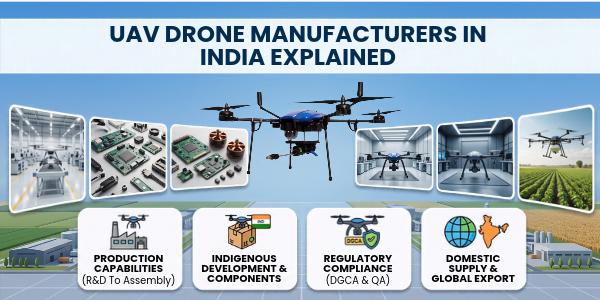
UAV drone manufacturers in India are at the centre of one of the country's most strategic industrial transformations. Five years ago, the Indian drone market was dominated by imported hardware -- primarily from Chinese manufacturers like DJI -- with limited indigenous capability outside a handful of defence-focused organisations. Today, India has over 400 registered drone manufacturers, a robust DGCA Type Certification framework, and government investment of Rs 120 crore under the PLI scheme specifically designed to build world-class indigenous UAV manufacturing capability. The government's stated goal is to make India a global drone hub by 2030, and the manufacturing ecosystem is scaling at a pace that is beginning to make that goal credible. This guide profiles the major categories of UAV manufacturers in India, explains what each one makes and for whom, and helps buyers and investors understand the landscape clearly.1. Why Are UAV Drone Manufacturers in India Growing So Rapidly?UAV drone manufacturers in India are growing rapidly because demand from both government and commercial sectors is scaling faster than the imported supply chain can sustainably serve -- and government policy has actively tilted the playing field toward domestic producers.Three converging forces are driving this growth:Government demand: India's armed forces, border security agencies, and paramilitary organisations have dramatically increased UAV procurement. The SVAMITVA village mapping programme deployed drones at national scale. NAMO Drone Didi is placing drones in the hands of 15,000 Women Self Help Groups. Each of these programmes specifies or prefers domestically manufactured platforms.Commercial demand: Agriculture, infrastructure inspection, survey and mapping, and logistics sectors are all scaling drone adoption simultaneously. Precision agriculture drone services alone represent a market of millions of hectares requiring certified platform supply that imported drones struggle to serve cost-effectively given customs duties, spare parts logistics, and currency exposure.Policy tilt toward indigenous manufacturing: The PLI scheme provides financial incentives for drone and component manufacturing in India. Import restrictions on drones and drone components from countries sharing land borders with India (effectively targeting Chinese imports) have dramatically shifted procurement toward domestic alternatives. Government procurement policies increasingly require indigenous certification for public sector contracts.Are you currently using imported drones for commercial operations? Understanding what Indian manufacturers now offer is essential context for your next procurement decision.2. UAV Drone Manufacturers in India: Category OverviewIndian UAV manufacturers can be broadly grouped into five categories based on their primary product focus:CategoryPrimary ProductsKey MarketsDefence UAV manufacturersISR drones, loitering munitions, UCAV platformsIndian Army, Navy, Air Force, ParamilitaryAgricultural UAV manufacturersSpraying drones, seeding dronesFarmers, cooperatives, agri-service companiesSurvey and mapping manufacturersRGB and multispectral mapping dronesConstruction, land records, miningIndustrial inspection manufacturersThermal and inspection dronesEnergy, utilities, infrastructureEmerging multi-role manufacturersConfigurable multi-payload platformsMultiple commercial verticalsMost of India's leading UAV manufacturers operate across two or more of these categories, building common airframe platforms that can be configured for different payload and mission types.3. Top UAV Drone Manufacturers in India: Defence Sector3.1. ideaForge TechnologyideaForge is India's largest and most widely deployed indigenous UAV manufacturer, with the broadest operational footprint of domestically made drones across the Indian Army, Navy, Air Force, CRPF, BSF, and state police forces. The company's Q4i, Q6, SWITCH, and NETRA platforms span tactical ISR, border surveillance, and disaster response applications. ideaForge has completed over 400,000 operational flights, holds multiple DGCA Type Certifications, and is the benchmark reference for what indigenous Indian UAV manufacturing can achieve at scale.Key platform specifications:SWITCH platform: VTOL fixed-wing hybrid, 120-minute endurance, 15 km operational radiusQ6 platform: Hexacopter survey and surveillance, 42 MP camera, 45-minute enduranceNETRA: Compact ISR quadcopter, 30-minute endurance, designed for rapid deployment3.2. Bharat Electronics Limited (BEL)BEL's dedicated Strategic Business Unit for unmanned systems in Bengaluru develops drone systems for the Indian military in partnership with DRDO, foreign OEMs, and startups. BEL produces ground control stations, communication systems, and integrates UAV platforms for defence ISR and anti-drone applications. Its Rs 74,000 crore order book as of April 2026 includes significant unmanned systems programmes.3.3. Hindustan Aeronautics Limited (HAL)HAL's ARDC (Aircraft Research and Design Centre) is developing the CATS Warrior -- India's first loyal wingman UCAV designed to fly alongside manned fighters and conduct autonomous strike and EW missions. HAL also produces the Rustom-2 (Tapas BH-201) MALE surveillance UAV targeting 18+ hour endurance and 250+ km operational range. HAL represents India's strategic intent to develop military-grade indigenous UAV platforms without relying on imported systems.3.4. DRDO (Defence Research and Development Organisation)DRDO is the R&D backbone of India's indigenous military UAV programme, responsible for fundamental technology development that commercial manufacturers then scale. Key DRDO programmes include the Tapas (Tactical Airborne Platform for Aerial Surveillance), ARCHER loitering munition, and various micro and nano UAV programmes for special operations.3.5. Paras Aerospace Private LimitedParas Aerospace (subsidiary of Paras Defence and Space Technologies) manufactures drones for military, agricultural, and delivery applications. Its Paras Agri Copter is DGCA-licensed for agricultural spraying, and the company's defence platforms serve ISR requirements across multiple paramilitary users.4. UAV Drone Manufacturers in India: Agriculture Sector4.1. Why Agriculture Drives the Largest Commercial Drone Manufacturing MarketAgricultural applications drive the largest volume of commercial UAV manufacturing in India because the addressable market is enormous and the economics are compelling. India has 140 million hectares of agricultural land, 89% of farms are smallholdings under 2 hectares, and labour costs during peak crop protection seasons are rising sharply. Drones that deliver precision spraying, crop health monitoring, and seed spreading at scale are not a luxury -- they are an economic necessity for competitiveness.4.2. Key Agricultural UAV Manufacturers in IndiaSeveral Indian companies have emerged as leading agricultural UAV manufacturers with DGCA Type Certified platforms:IdeaForge (AgriCopter series): IdeaForge's agricultural platform variants bring the company's proven airframe technology to agricultural spraying and monitoring applications.VFLYX / EFT India: EFT's agricultural drones including the E410P and E416P series are among the most widely deployed agricultural spraying platforms in India, offering 10 to 40 litre tank capacity options with DGCA Type Certification. These platforms are particularly popular among agri-drone service operators building commercial spraying businesses.TartanSense: A Bengaluru-based agri-robotics company developing AI-powered autonomous agricultural robots and drones for precision farm management, including weed detection and targeted herbicide application.AgriForce Drones: Manufactures DGCA-certified agricultural spraying platforms designed specifically for Indian crop and terrain conditions, with models optimised for paddy, wheat, cotton, and sugarcane spraying.Key specifications to compare across Indian agricultural UAV manufacturers:SpecificationWhat to PrioritiseTank capacity10 to 40 litres; larger = fewer refillsNozzle count4 to 8 nozzles; affects spray uniformityFlight time at payload10 to 23 minutes typicalRTK GPS integrationEssential for accurate spray path coverageDGCA Type CertificationMandatory for commercial useAfter-sales service networkCritical for rural operational areas5. UAV Drone Manufacturers in India: Survey, Mapping, and Inspection5.1. Survey and Mapping Platform ManufacturersSeveral Indian manufacturers produce DGCA Type Certified survey drones for topographic mapping, construction documentation, and cadastral survey applications including the SVAMITVA programme:IdeaForge Q6: Hexacopter platform carrying a 42 MP RGB camera with integrated RTK GPS, producing survey-grade orthomosaics and 3D models. Widely used for land record mapping and construction site surveys.SurveyYan V1: A compact fixed-wing VTOL platform designed for large-area surveys, capable of mapping 550 hectares per flight at standard altitude. Popular for large infrastructure corridor surveys.RFLY Innovations Micro S1: A compact multirotor survey drone designed for medium-area surveys with integrated RTK GPS, suitable for construction site documentation and agricultural field mapping.VTOL Aviation India (AARAV series): Fixed-wing VTOL platforms designed for large-area agricultural, forest, and infrastructure surveys, with endurance options from 90 to 180 minutes per flight.5.2. Industrial Inspection UAV ManufacturersAsteria Aerospace: Bengaluru-based manufacturer of enterprise-grade UAV systems including the A200 and Halo inspection platforms. Asteria drones are used for power line inspection, solar farm thermal surveys, and industrial asset monitoring. The company was acquired by Jio Platforms as part of a strategic drone technology investment.Detect Technologies: An AI and drone technology company focused on industrial inspection, particularly for oil and gas infrastructure. Detect Technologies' UGICS (Universal Gas Intelligent Inspection and Cleaning System) combines drone inspection with AI-powered defect detection for pipeline and refinery applications.Omnipresent Robot Technologies: Develops autonomous inspection drone systems for industrial facilities, including confined space inspection platforms designed for environments inaccessible to standard commercial drones.6. UAV Drone Manufacturers in India: Emerging Multi-Role Platforms6.1. Throttle Aerospace Systems (TAS)TAS is an IIT Bombay-incubated startup developing modular multi-role UAV platforms and indigenous drone subsystems including flight controllers, avionics, and ground control systems. The company focuses on reducing India's dependence on imported drone components -- a critical bottleneck in the supply chain that the PLI scheme is specifically designed to address.6.2. Skylark LabsSkylark Labs develops AI-powered drone software and autonomous systems for both surveillance and industrial applications. While primarily a software and AI company, Skylark integrates with multiple hardware platforms and represents the growing trend of Indian companies building competitive advantage in drone intelligence rather than just drone hardware.6.3. NewSpace Research and TechnologiesNewSpace develops indigenous fixed-wing UAV platforms for both defence and commercial applications, with a focus on advanced autonomy, long endurance, and indigenous subsystem development. The company has received backing from India's defence ecosystem and is working on MALE-class platforms that could reduce India's reliance on imported strategic UAVs.7. How DGCA Type Certification Works for UAV Manufacturers in IndiaDGCA Type Certification is the mandatory quality and airworthiness approval that UAV manufacturers must obtain before their drones can be legally registered for commercial operation in India. It is the primary quality gate that separates legitimate commercial drone platforms from uncertified hardware.The Type Certification process for Indian manufacturers:Step 1 -- Documentation submission. The manufacturer submits complete technical documentation covering design specifications, materials, performance data, and manufacturing quality standards to the DGCA.Step 2 -- Prototype testing. The drone prototype undergoes independent testing by the Quality Council of India (QCI) or DGCA-accredited testing agencies, covering flight performance, safety systems, structural integrity, and NPNT (No Permission, No Takeoff) compliance.Step 3 -- DGCA review and assessment. The DGCA reviews test results against defined standards and conducts its own assessment of compliance with all applicable requirements.Step 4 -- Certificate issuance. If all requirements are met, the DGCA issues a Type Certificate for the specific model and variant. This certificate appears on the Digital Sky Platform's Type Certified drone list.Step 5 -- Post-certification compliance. Manufacturers must maintain the conditions of certification and report any design changes that could affect airworthiness. Significant modifications require a supplemental Type Certificate or re-certification.For buyers, the Type Certification list on the Digital Sky Platform is the only authoritative verification source. Never purchase a drone for commercial use without confirming its Type Certificate status directly on the platform.8. How to Choose a UAV Manufacturer in India: Step-by-Step Buying FrameworkStep 1 -- Define your application. Agriculture, survey, inspection, surveillance, or delivery? Each application has manufacturers who specialise in the relevant platform design and payload integration.Step 2 -- Verify DGCA Type Certification. Check the Digital Sky Platform's Type Certified drone list for the exact model and variant you are considering. Do not accept manufacturer claims alone -- verify directly.Step 3 -- Assess after-sales service network. For agricultural operations in rural areas, the availability of trained service technicians and spare parts within a reasonable distance of your operating area is as important as platform specifications. Ask manufacturers specifically about their service centre network in your state.Step 4 -- Evaluate PLI and subsidy eligibility. If you are purchasing under NAMO Drone Didi, a state government subsidy scheme, or a corporate procurement programme, confirm that the manufacturer and specific model qualify under the applicable eligibility criteria.Step 5 -- Compare total cost of ownership. Platform acquisition cost is only one component. Battery replacement cycles, maintenance costs, spare parts pricing, and service contract costs all contribute to total five-year cost of ownership. Request a total cost model from the manufacturer before finalising any purchase.Step 6 -- Confirm pilot certification pathway. Buying a drone without a certified pilot to operate it is a regulatory dead end. Confirm your operator certification pathway through a DGCA-approved training programme before or alongside hardware procurement.9. India's UAV Manufacturing Ecosystem: Key Policy EnablersIndia's government has implemented several policies that are directly shaping which UAV manufacturers succeed:PLI Drone Scheme: Rs 120 crore in incentives for drone and component manufacturers meeting production value and export targetsImport restrictions: Drones and components from countries sharing land borders require government approval, effectively reducing Chinese drone importsDGCA Type Certification mandate: Creates a quality baseline that raises the bar for all manufacturers entering the commercial marketGovernment procurement preference: Central and state government tenders increasingly require indigenous Type Certified platformsDefence Atmanirbhar Bharat: Defines priority indigenous development programmes for military UAV platforms, with HAL, BEL, and ideaForge as primary beneficiariesThese policies collectively create a structural advantage for Indian UAV manufacturers over imported alternatives that will continue to strengthen as India's manufacturing capability scales. For organisations using drone-as-a-service platforms or evaluating drone equipment purchases, understanding this policy landscape is essential context for long-term procurement decisions.Final ThoughtsUAV drone manufacturers in India have transformed the country's drone landscape from an import-dependent market into an increasingly self-sufficient manufacturing ecosystem over the past five years. From ideaForge's battle-tested indigenous defence platforms and BEL's integrated defence systems to agricultural spraying drone makers serving India's smallholder farmers and survey platform manufacturers supporting national mapping programmes, the breadth and depth of India's indigenous UAV manufacturing capability is growing rapidly.Whether you are a defence procurement officer, an agricultural service entrepreneur, a construction company evaluating survey solutions, or an investor assessing the sector, the right engagement starts with understanding who makes what, what it costs, and how the regulatory framework shapes commercial viability for each platform category.
Oct 13, 2026 | 2 min read

test
Oct 08, 2026 | 2 min read

test
Oct 08, 2026 | 2 min read

Whether you're a farmer seeking precision agriculture solutions, an entrepreneur exploring commercial opportunities, or an enterprise requiring advanced aerial surveillance and inspection capabilities, our comprehensive range of UAVs is engineered to meet your exact needs. With DGCA certification, in-house R&D, and a commitment to innovation, we provide seamless drone operations backed by state-of-the-art engineering and end-to-end support. From agriculture and logistics to defense and infrastructure, our unmanned aircraft systems deliver unmatched efficiency and precision across industries. Join hundreds of satisfied clients who've transformed their operations with our industrial-grade solutions featuring AI-powered drones, comprehensive maintenance packages, and cutting-edge sensors designed for dynamic applications across multiple sectors. Partner with Garuda Aerospace, the best drone manufacturing company recognized for delivering cutting-edge drone technology that drives real results.