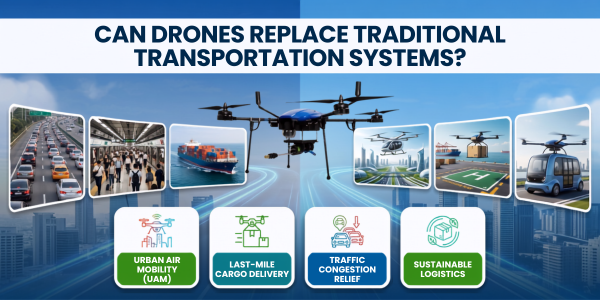
Drones in transportation are moving from pilot projects to real-world operations faster than most industries expected. Trucks, trains, ships, and planes have carried the world's goods and people for over a century, but rising fuel costs, traffic congestion, and delivery delays are pushing businesses to look upward. The question is no longer whether drones belong in transportation, but how far they can go. This article looks at where drones already fit into transport networks, what is holding them back, and whether they can genuinely replace the systems we rely on today.
1. What Is Driving the Rise of Drones in Transportation?
Rising congestion and delivery delays are the biggest reasons drones in transportation are gaining attention. Urban roads are more crowded than ever, and last-mile delivery already accounts for a large share of total shipping costs. At the same time, e-commerce volumes keep growing, and customers expect faster turnaround times than road vehicles can consistently deliver.
Labor shortages are adding further pressure. Many countries are struggling to fill driving and logistics roles, which makes autonomous or semi-autonomous alternatives more attractive to operators. Drones offer a way to move smaller loads quickly without needing a driver for every trip, which is why interest in industrial drone applications has grown steadily across sectors that depend on time-sensitive movement of goods.
Environmental regulations are also playing a role. Electric drones produce far fewer emissions than diesel trucks, and governments pushing for greener logistics are more willing to test drone corridors as a supplement to road transport.
2. How Do Drones in Transportation Compare to Traditional Systems?
Drones win on speed and direct routing, while traditional systems still win on capacity and cost per unit of weight. A drone can travel in a straight line from origin to destination, avoiding traffic signals, road diversions, and congestion entirely. A truck cannot do this, no matter how well the route is planned.
However, traditional vehicles still carry far more volume per trip. A single truck can move what would take dozens of drone flights to complete. This is why most experts see drones as a complement to trucks, ships, and trains rather than a full replacement, at least in the near term.
The comparison changes depending on the use case. For urgent, lightweight, or hard-to-reach deliveries, drones already outperform road transport. For bulk freight over long distances, conventional transportation remains far more practical and economical.
Factor | Drones in Transportation | Traditional Transportation |
Speed on short routes | Very high, direct point-to-point travel | Limited by traffic and road conditions |
Load capacity | Low, typically a few kilograms | High, built for bulk freight |
Route flexibility | Bypasses roads and congestion | Fixed to roads, rail lines, or shipping lanes |
Cost per unit shipped | Low for small, urgent loads | Low for large-volume shipments |
Weather dependency | High, grounded by storms and strong wind | Low, generally weather resilient |
Access to remote areas | Excellent, no road access needed | Limited without existing infrastructure |
Emissions | Low, mostly electric powered | Higher, especially fuel-based fleets |
3. Step-by-Step: How Drones Are Being Integrated into Transportation Networks
Drone integration into transportation follows a fairly consistent pattern across industries, moving from testing to limited use to broader rollout. Here is how that process typically unfolds.
Step | Stage | What Happens |
Step 1 | Identifying the right use case | Operators assess where drones add clear value, such as remote delivery, emergency response, or inspection of hard-to-reach infrastructure like bridges and rail lines |
Step 2 | Regulatory approval and airspace mapping | Operators secure clearance from aviation authorities and map safe corridors that avoid restricted zones, airports, and populated flight paths |
Step 3 | Small-scale pilot testing | Limited trials run on short routes under controlled conditions to measure reliability, battery performance, and delivery accuracy |
Step 4 | Integration with existing logistics infrastructure | Drones connect to warehouse systems, tracking software, and ground transport schedules so aerial and road-based delivery work together |
Step 5 | Scaling to regular operations | Once safety and performance data support wider use, operators expand drone routes, often pairing them with ground vehicles for last-mile handoffs |
This staged approach explains why drones in transportation are growing steadily rather than replacing road and rail overnight.
4. What Are the Key Benefits of Drones in Transportation?
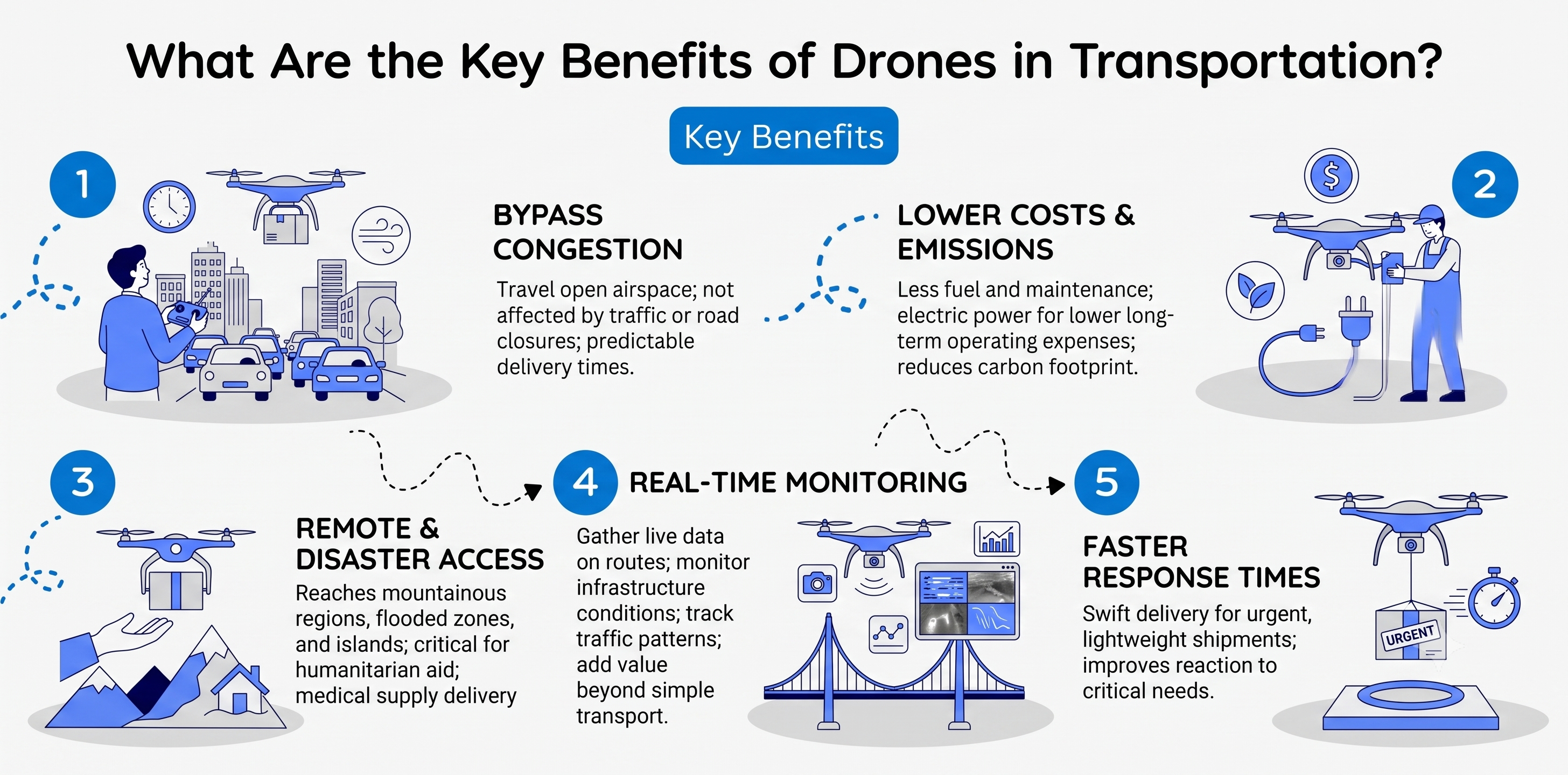
The biggest benefit of drones in transportation is the ability to bypass ground-level congestion entirely. Because drones travel through open airspace, they are not affected by traffic jams, road closures, or poor surface conditions, which makes delivery times far more predictable.
Cost savings follow closely behind. Drones require less fuel and lower maintenance compared to trucks, and many models run on electric power, which reduces long-term operating expenses. This is one reason precision agriculture drone solutions have expanded so quickly in farming regions where ground access is limited or seasonal.
Access to remote and disaster-affected areas is another major advantage. Drones can reach mountainous regions, flooded zones, or islands where roads either do not exist or have been damaged, making them valuable for humanitarian aid and emergency medical supply runs.
Finally, drones support real-time monitoring alongside delivery. The same aerial systems used for transport can also gather live data on routes, infrastructure condition, and traffic patterns, adding value beyond simple point-to-point movement.
Quick summary of key benefits:
- Bypasses ground congestion for predictable delivery times
- Lower fuel and maintenance costs compared to trucks
- Reduced carbon emissions with electric-powered fleets
- Reliable access to remote, rural, or disaster-hit areas
- Live route and infrastructure monitoring alongside delivery
- Faster response times for urgent, lightweight shipments
5. What Challenges Stand in the Way of Drones in Transportation?
Airspace regulation is the single biggest barrier to wider drone adoption in transportation. Commercial airspace is tightly controlled, and integrating drone traffic with existing aviation systems requires careful coordination to avoid collisions and maintain public safety.
Battery life and payload capacity remain practical limitations. Most delivery drones can only carry a few kilograms over limited distances before needing to recharge, which restricts their use to smaller shipments rather than bulk freight.
Weather sensitivity is another ongoing issue. Strong winds, heavy rain, and storms can ground drone fleets entirely, whereas trucks and trains can generally continue operating in most weather conditions with only minor delays.
Infrastructure gaps also slow progress. Dense cities often lack safe landing zones for drones, especially near high-rise apartment buildings, which makes last-mile handoff to the actual recipient complicated. Programs built around structured drone pilot training are helping address the human side of this challenge by preparing certified operators who can manage these constraints safely.
Quick summary of key challenges:
- Strict airspace regulations and limited approvals
- Restricted battery life and payload capacity
- High sensitivity to wind, rain, and storms
- Lack of safe landing zones in dense urban areas
- Need for certified, trained drone operators
6. Can Drones Fully Replace Traditional Transportation Systems?
Drones cannot fully replace traditional transportation systems in the near future, but they can meaningfully reduce dependence on them for specific tasks. Bulk cargo, heavy freight, and long-haul passenger movement will continue to rely on trucks, ships, trains, and planes because of scale and cost efficiency that drones cannot yet match.
Where drones make the strongest case is in the last mile and in situations where speed matters more than volume. Medical deliveries, emergency response, and access to remote locations are areas where drones already outperform conventional options. Businesses exploring industrial drone solutions are finding this hybrid model, aerial for speed and ground transport for scale, to be the most realistic path forward.
Rather than a full replacement, the more accurate picture is a layered transportation network, where drones handle specific segments and traditional systems continue carrying the bulk of the load.
7. What Does the Future Hold for Drones in Transportation?
The future of drones in transportation points toward tighter integration with existing networks rather than standalone operation. Expect hybrid delivery models where drones handle the first or last leg of a journey while trucks and rail cover the middle distance, combining speed with volume capacity.
Advances in battery technology and autonomous navigation will gradually extend drone range and payload limits, narrowing the gap with conventional vehicles. At the same time, regulatory frameworks are maturing, with more countries opening structured airspace corridors for commercial drone traffic.
Safety and monitoring will also expand. Many transportation authorities are already exploring safety and security drone solutions to oversee infrastructure, traffic flow, and emergency response alongside actual cargo movement, turning drones into a monitoring layer as much as a delivery tool.
Growth in trained personnel will support this shift as well, with more professionals entering the field through recognized drone training programs that prepare certified pilots for commercial operations.
Where drones fit best right now:
Use Case | Better Suited To |
Bulk freight over long distances | Traditional transportation |
Urgent medical or emergency supply | Drones |
Delivery to remote or disaster-hit areas | Drones |
High-volume urban distribution | Traditional transportation |
Last-mile delivery in low-density areas | Drones |
Infrastructure and route monitoring | Drones |
Conclusion
Drones in transportation are no longer a futuristic concept. They are already reducing delivery times, cutting costs, and reaching places traditional vehicles cannot. That said, the idea of drones fully replacing trucks, trains, ships, and planes is not realistic in the short term due to payload limits, weather sensitivity, and regulatory hurdles. The more likely outcome is a blended transportation system, where drones handle speed-critical and hard-to-reach tasks while conventional transport continues to carry bulk freight. As technology, regulation, and infrastructure mature together, the role of drones in transportation will keep expanding, even if a complete replacement of ground and sea transport remains far off.
FAQs
Are drones already used in transportation today? Yes, drones are currently used for medical deliveries, remote area supply, infrastructure inspection, and short-distance cargo movement.
What is the biggest limitation of drones in transportation? Limited battery life and payload capacity are the biggest constraints, restricting drones to lighter loads over shorter distances.
Will drones replace trucks and trains completely? No, drones are expected to complement rather than replace bulk transportation methods like trucks, trains, and ships.
What industries benefit most from drones in transportation? Healthcare, agriculture, disaster relief, and e-commerce logistics currently see the most practical benefits from drone-based transport.