Drone in war has fundamentally altered the nature of military conflict in the 21st century. What began as a tool for surveillance and reconnaissance has evolved into one of the most consequential technological shifts in military history reshaping battlefield tactics, redefining deterrence, compressing decision-making timelines, and blurring the line between conventional and irregular warfare. From the deserts of Ukraine to the mountains of the India-Pakistan border, unmanned aerial systems are no longer a supplementary capability they are increasingly central to how modern militaries fight, signal, and deter.
For India specifically, the integration of drones into its military architecture is accelerating rapidly, driven by the lessons of recent conflicts, ambitious domestic manufacturing programmes, and a strategic vision to be a leading drone power by 2030. This article explores how drone in war are transforming military operations globally, how India is building its drone force, and what the future of unmanned warfare looks like in one of the world's most strategically sensitive regions.
Drone in War: A Global Revolution
The past decade has produced some of the most dramatic demonstrations of drone in war ever witnessed. Several landmark conflicts have permanently changed how military planners think about unmanned systems:
Azerbaijan vs Armenia (2020 and 2023) — Azerbaijan's use of Turkish Bayraktar TB2 drones and Israeli loitering munitions against Armenian armour, artillery, and logistics infrastructure demonstrated definitively that relatively affordable unmanned systems could neutralise expensive conventional military equipment at scale. Entire columns of tanks and air defence systems were destroyed with minimal risk to Azerbaijani personnel — a preview of what drone-dominant warfare could look like.
Russia-Ukraine War — Ukraine has arguably produced the most extensive and innovative application of drone in war in history. Cheap FPV (First Person View) drones costing a few hundred dollars have been used for precision strikes against tanks, artillery positions, and supply lines. Long-range UAVs have struck targets hundreds of kilometres inside Russian territory. The war has demonstrated that mass drone innovation, rapid adaptation, and affordable precision can counter numerical and technological advantages in conventional forces — revealing critical vulnerabilities in even sophisticated air defence networks.
Israel-Iran Conflict — Loitering munitions, precision drones, and commercial quadcopters have been used alongside or instead of manned airpower in congested, contested airspace, demonstrating how unmanned systems can complement traditional military operations across multiple domains simultaneously.
The lessons from these conflicts are being carefully studied by every major military in the world — including India and Pakistan. The fundamental insight is consistent: drones provide accuracy without the political dangers of manned incursions, can weaken traditional air defence systems at low cost, and create coercive tools that nations can deploy with a degree of deniability that manned platforms cannot offer.
How Drone in Warfare Works: Key Roles and Capabilities
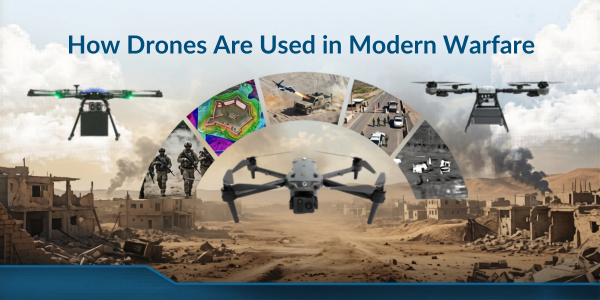
Modern drone in war encompasses a wide spectrum of capabilities, from small commercial quadcopters used for tactical reconnaissance to large, sophisticated unmanned combat aerial vehicles (UCAVs) capable of precision strikes across long ranges.
Intelligence, Surveillance, and Reconnaissance (ISR)
The original and still most widespread military application of drones is ISR. High-altitude, long-endurance (HALE) and medium-altitude, long-endurance (MALE) platforms can maintain persistent surveillance over large areas for extended periods providing real-time intelligence on enemy movements, positions, and activities that was previously only possible with manned aircraft or satellites.
The advantage of drones in ISR is not just persistence but risk an unmanned platform can fly over contested or denied airspace without risking a pilot's life. This makes drone surveillance both operationally more flexible and politically less costly than manned reconnaissance.
Precision Strike and Attack
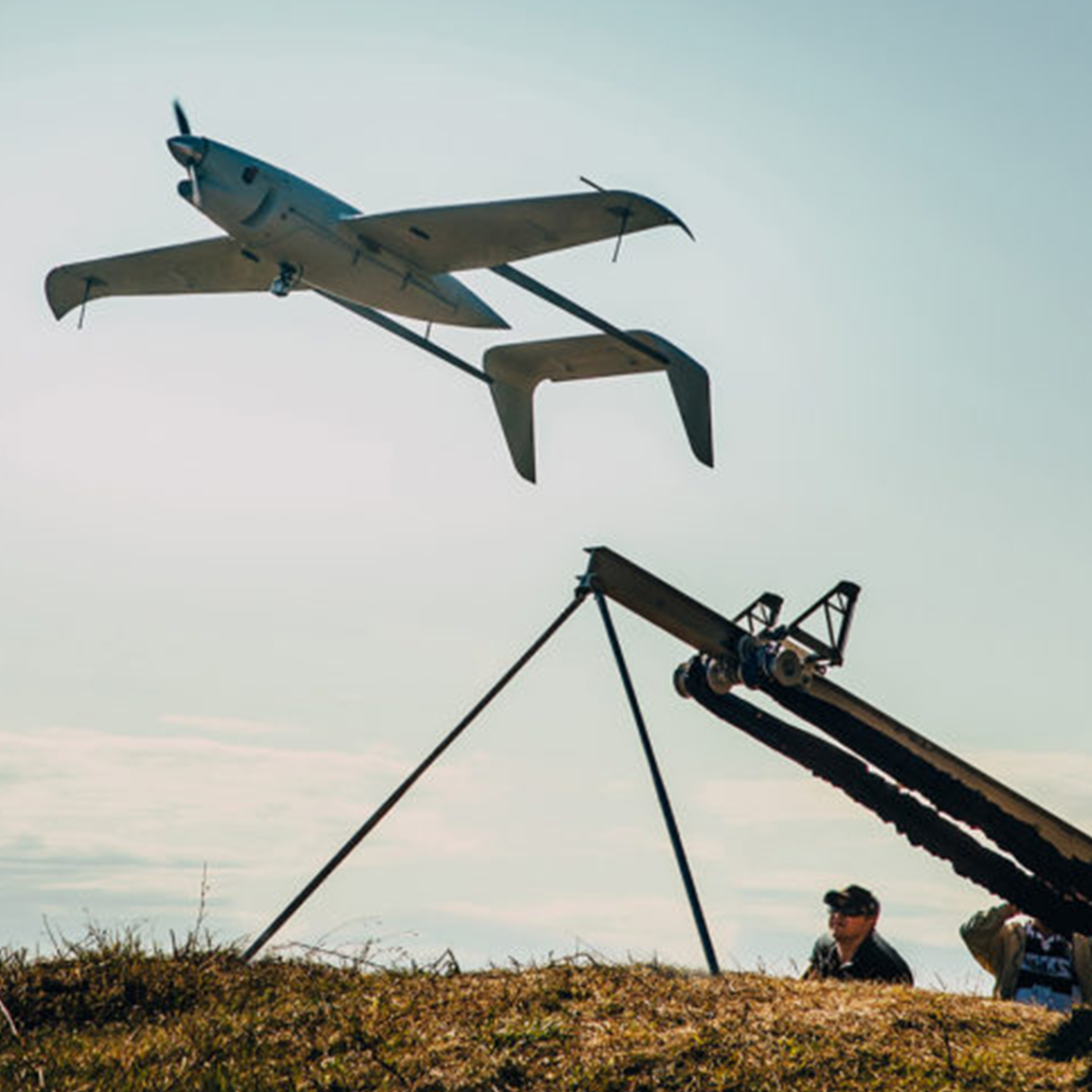
Armed drones, from Turkey's Bayraktar TB2 to America's MQ-9 Reaper have demonstrated the capacity to deliver precision munitions against high-value targets with minimal collateral damage. The combination of persistent surveillance and strike capability in a single platform creates what military planners call a "sensor-to-shooter" chain the ability to identify, track, and engage a target in a compressed timeframe without the logistical complexity of coordinating separate ISR and strike aircraft.
Loitering munitions, sometimes called "kamikaze drones" take this concept further. These are single-use platforms that can orbit a target area for extended periods before diving into their target when conditions are right. They effectively combine the patience of a surveillance drone with the lethality of a precision missile.
Swarm Tactics
One of the most strategically disruptive developments in drone in war is swarm technology the coordinated deployment of large numbers of relatively inexpensive drones operating as a single, distributed system. A drone swarm can overwhelm traditional air defence systems by presenting too many simultaneous targets for point-defence weapons to engage. Swarms can be used for saturation attacks on air defence networks, intelligence gathering across wide areas, electronic warfare, and coordinated strikes on distributed targets.
The same swarm coordination principles being developed for military applications have direct parallels in civilian drone operations; the same technology that enables precision agriculture solutions using coordinated multi-drone fleet operations is foundational to military swarm development.
Electronic Warfare and Jamming
Drones are increasingly being used for electronic warfare missions jamming enemy communications and radar systems, spoofing GPS signals, and disrupting command and control networks. This capability is particularly valuable in the early phases of a conflict, where degrading the enemy's situational awareness and communication infrastructure can create decisive advantages before conventional forces engage.
Counter-Drone Operations
As drones have proliferated, so has the development of counter-drone (C-UAS) capabilities. Drone-on-drone interception, directed energy weapons, radio frequency jamming, GPS spoofing, and netted radar systems are all being developed and deployed to counter the threat posed by enemy UAVs. This counter-drone dynamic is creating a technological arms race that is reshaping defence procurement priorities around the world.
India's Drone in Warfare Strategy
India's integration of drone in war capabilities is one of the most significant military modernisation programmes underway in the Indo-Pacific. New Delhi's approach follows three interconnected tracks: production and procurement, operational training and doctrine, and doctrinal recalibration toward network-centric warfare.
Current Indian Military Drone Inventory
India's current recognised drone force numbers approximately 179 active unmanned aircraft, made up largely of Israeli-originated designs. The fleet includes:
- IAI Searcher Mk.I/II — The backbone of India's tactical ISR capability, with approximately 108 units in service
- IAI Heron 1 — Medium-altitude long-endurance (MALE) platform used for persistent surveillance, with approximately 65 units across Army and Navy variants
- IAI Heron TP — Advanced MALE platform with greater endurance and payload capacity; 4 units
- General Atomics MQ-9B SeaGuardian — Two units currently on lease from the United States, primarily for maritime domain awareness
While modest by the standards of the United States or China, India's drone fleet is composed of relatively modern platforms, and the expansion trajectory is among the most aggressive of any military in the world. India is slated to procure the full MQ-9B Predator platform from the United States a procurement that will dramatically enhance both ISR and potential strike capabilities. Additionally, Larsen & Toubro and General Atomics have agreed to co-produce MALE drones domestically, which would represent a major breakthrough for India's indigenous drone manufacturing capability.
The May 2025 India-Pakistan Conflict: A Turning Point
The May 2025 India-Pakistan crisis marked a qualitative turning point in the regional use of drone in war. For the first time in the India-Pakistan rivalry, unmanned systems were deployed not merely for surveillance or cross-border reconnaissance, but for coercive signalling, probing of air defences, and limited strikes against sensitive installations.
Both states employed drones at unprecedented scale using UAV incursions to test radar coverage, identify gaps in low-altitude air defence networks, and gather real-time intelligence on adversary deployments. The crisis demonstrated several important characteristics of modern drone warfare in a nuclearised environment:
Calibrated coercion — Drones provided a tool for signalling resolve while avoiding immediate escalation to manned airpower. Their use was visible enough to communicate intent, yet deniable enough to preserve escalation space — a new form of strategic messaging that conventional military assets cannot replicate.
Air defence saturation — Systems optimised for aircraft and ballistic missiles struggled to detect small, low-signature UAVs operating at low altitude or in numbers. This exposed critical vulnerabilities in existing defence frameworks that both sides are now racing to address.
Compressed decision-making — The ambiguity surrounding drone launch origins, flight paths, and intended targets compressed decision-making timelines in dangerous ways. In a nuclearised environment, uncertainty about whether a UAV approaching a sensitive facility represents a limited probe or a pre-emptive strike creates escalation risks that previous military technologies did not generate.
The crisis underscored that drones now occupy the grey zone between regular and irregular warfare in South Asia, creating new escalation pathways that are faster, less transparent, and potentially more dangerous than those seen in previous crises.

A critical dimension of India's drone in warfare strategy is the development of indigenous manufacturing capability. New Delhi has introduced several major policy initiatives to accelerate this:
The Production-Linked Incentive (PLI) Drone Scheme was launched in 2020 to incentivise domestic drone production
The Drone Rules 2021 to simplify regulatory frameworks for both civilian and military drone operations
A $234 million Drone Incentive Program announced after the May 2025 conflict, targeting not just drones but drone components, software, and counter-drone technologies
Reduction of GST on drone production from 18–28% to 5% to make domestic manufacturing more commercially viable
India's indigenous drone development programme aims to produce a wide range of platforms, from nano quadcopters for infantry-level ISR to MALE systems and advanced stealthy unmanned combat vehicles. The Ghatak UCAV and Loyal Wingman projects are part of a long-term vision for stealthy, deep-strike unmanned platforms that integrate directly with India's command, control, and sensor networks.
However, significant challenges remain. India has been excessively reliant on Chinese components for drone production, and a 2023 ban on Chinese components in military drones has complicated supply chains. The lack of clarity over procurement timelines and operational requirements also impedes private manufacturers from committing to large-scale investment, a gap that must be addressed if India's indigenous drone industry is to reach its potential.
The same technology foundation driving India's military drone ambitions also underlies the civilian drone revolution. The GPS navigation, autonomous flight control, and sensor integration technologies being developed for defence applications power the crop health monitoring, precision spraying, and soil mapping services that are transforming Indian agriculture, demonstrating how deeply military and civilian drone innovation inform each other.
Drone in Warfare: Doctrinal and Strategic Implications
The integration of drone in war into India's military doctrine reflects a broader shift toward network-centric, multi-domain operations. The Indian military's vision is not simply to acquire more drones, but to wire them into integrated kill chains converging diverse data links, sensor networks, and strike platforms into a unified operational picture that enables faster, more precise, and more scalable military action.
Key elements of this doctrinal evolution include:
Infantry drone integration — The Indian Army is arming infantry battalions with drone platoons for both ISR and combat purposes, moving toward a force structure with a wide range of smaller drones per corps. The goal is to convert the battlefield into a sensor-rich, loitering-enabled, strike-capable domain.
Training infrastructure expansion — New Delhi has set goals to establish 19 drone training centres across India, reinforcing that technological training is an essential component of the curriculum for all army ranks. India's Border Security Force has already opened its first drone warfare school in Madhya Pradesh.
Maritime domain awareness — The Indian Navy operates naval drones primarily for maritime surveillance, with the MQ-9B Sea Guardian expected to add anti-submarine warfare capabilities though the congested and dynamic underwater domain presents significant operational challenges.
Counter-drone capability — India is developing layered air defence systems, HALE-based surveillance, and advanced optical and RF tracking systems specifically designed to counter the low-signature, low-altitude drone threats demonstrated during the May 2025 crisis.
In October 2025, the Indian military conducted the "Cold Start" tri-service drill a major exercise aimed at testing India's drone and counter-drone capabilities and improving air defence integration across Army, Navy, and Air Force. Such exercises are essential for building the interoperability that a genuinely joint unmanned warfare doctrine requires.
The civilian parallel to this training infrastructure is equally important. DGCA-approved drone pilot training programmes are building the certified operator base that both civilian drone services and, indirectly, the defence industrial ecosystem depend upon. As drone-as-a-service platforms scale across agriculture and infrastructure, the pilot talent, regulatory frameworks, and operational discipline being developed have direct relevance to India's broader drone capability ecosystem.
The Future of Drone in Warfare
The trajectory of drone in war points toward several developments that will further transform military operations over the coming decade:
AI-powered autonomy — Drones are transitioning from remotely piloted platforms to increasingly autonomous systems capable of navigating, identifying targets, and making engagement decisions with minimal human input. Greater autonomy reduces reliance on vulnerable data links, enables drones to operate in GPS-denied environments, and compresses engagement timelines further.
Directed energy counter-drone systems — High-powered lasers and microwave weapons that can disable or destroy drones at low cost per engagement are being developed by India, the United States, and China as answers to the saturation attack problem posed by drone swarms.
Miniaturisation and mass production — Advances in micro-electronics are enabling increasingly capable drones at lower cost and smaller size. Nano-drones small enough to fly through windows, and micro-drones that can be deployed by the hundreds from a single aircraft, are already in development.
Hypersonic drone integration — The combination of drone persistence with hypersonic speed drones that can loiter and then accelerate to hypersonic velocity for terminal attack represents the next frontier in unmanned strike capability.
Encrypted and resilient communication — As drone operations become more contested electronically, the development of secure, jam-resistant data links and AI-driven autonomous fallback navigation will become essential for reliable drone employment in high-threat environments.
Final Thoughts
Drone in war is no longer an emerging capability it is a defining feature of modern military conflict. The India-Pakistan crisis of May 2025, the Ukraine war, and conflicts across the Middle East and Caucasus have all demonstrated the same fundamental truth: unmanned systems are reshaping the battlefield in ways that conventional military doctrine was not designed to address.
For India, the challenge is not simply acquiring more drones but managing the doctrinal, industrial, and strategic dimensions of their integration into a coherent military capability. The race to develop indigenous platforms, build operational training infrastructure, and establish joint unmanned warfare doctrine will define India's military posture for the next generation.
The same technology ecosystem driving military innovation is simultaneously powering India's civilian drone revolution, from precision agriculture and infrastructure inspection to disease detection and logistics. As India's drone industry matures across both defence and civilian applications, the cross-pollination of innovation between these domains will only accelerate, making India's broader drone ecosystem one of the most strategically significant technology developments of the decade.