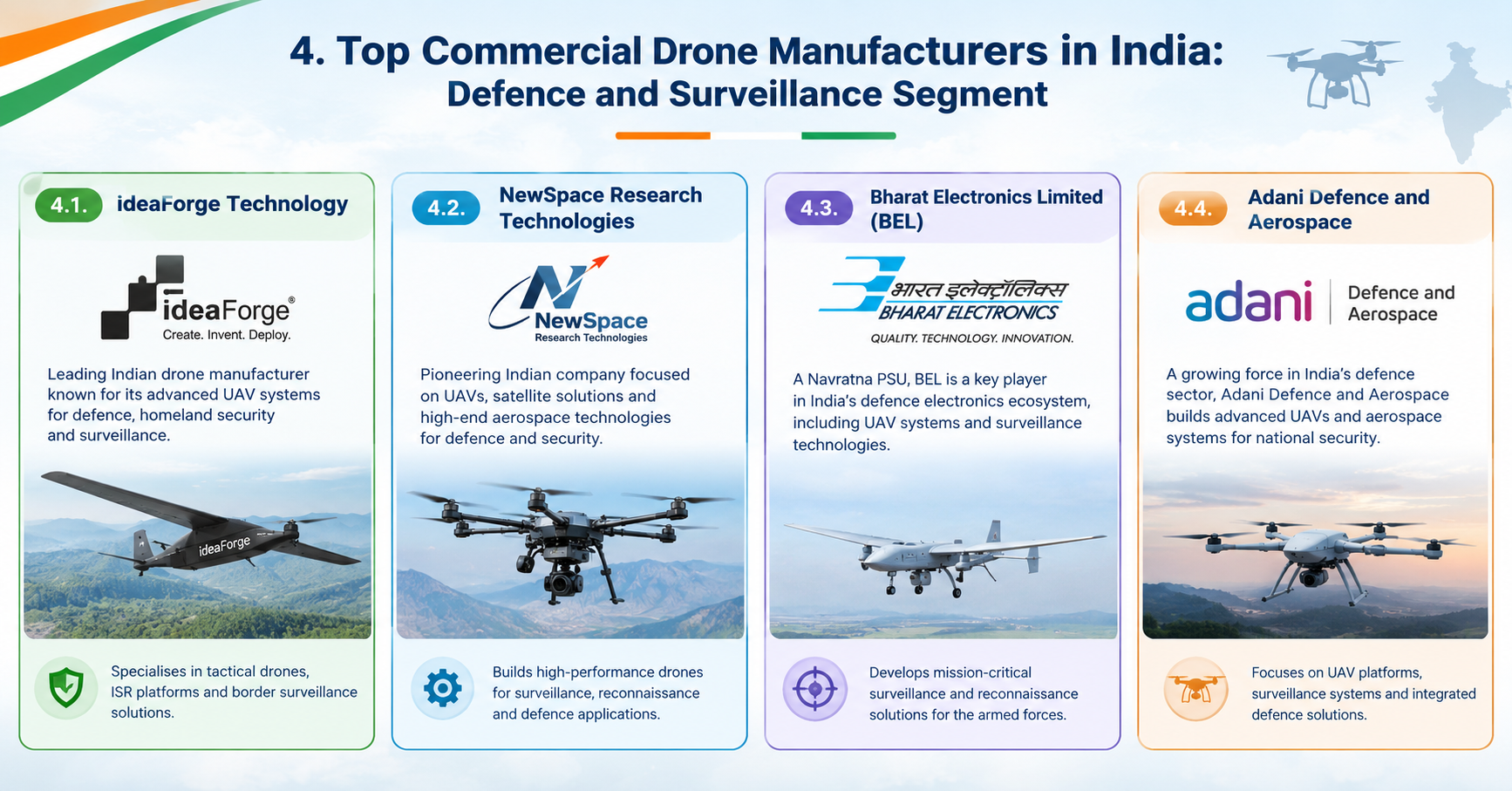
4.1. ideaForge Technology
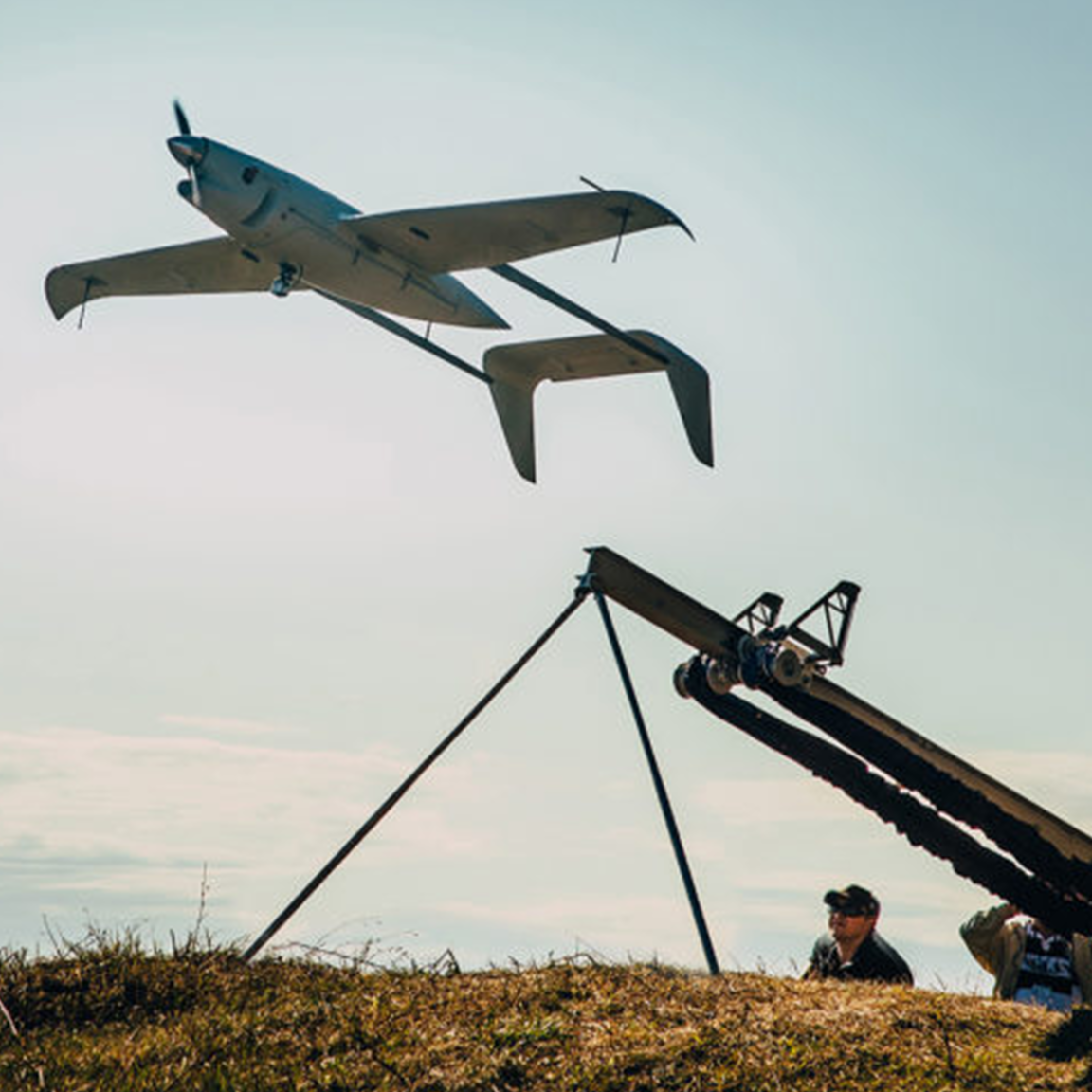
ideaForge is India's most established drone manufacturer by operational deployment, holding the largest installed base of indigenously manufactured UAVs across India's defence and paramilitary forces. The company's SWITCH, Zolt, and NETRA platforms have executed over 400,000 operational flights, and the SWITCH UAV is NATO-certified -- the only Indian drone platform to have achieved this benchmark. The company ranked third globally among dual-use drone manufacturers in the 2024 Drone Industry Insights rankings, a position no other Indian manufacturer has matched.
4.2. NewSpace Research Technologies
NewSpace is building some of the most technically ambitious UAV platforms in India, focusing on long-range loitering munitions, solar-electric endurance platforms, and autonomous naval combat air vehicles. The Sheshnaag-150 loitering munition achieved a 5-metre Circular Error Probable in maiden flight trials -- a precision benchmark that competes with the best global systems. The company has secured over USD 73 million in funding and operates under iDEX with direct Indian Army contracts.
4.3. Bharat Electronics Limited (BEL)
BEL is a Navratna PSU with an order book exceeding Rs 74,000 crore as of April 2026. Its drone and unmanned systems division produces the Archer MALE UAV, counter-drone systems developed with DRDO, and a full suite of UAV payloads, data links, and ground control stations. BEL's advantage is not agility -- it is institutional scale and the ability to integrate drone systems with command-and-control, radar, and electronic warfare infrastructure that no startup can replicate.
4.4. Adani Defence and Aerospace
The Adani Group's partnership with Israel's Elbit Systems produced India's first private UAV manufacturing facility in Hyderabad. The Drishti 10 MALE UAV has accumulated over 300,000 flight hours globally through the Elbit Hermes platform lineage and is now in operational service with the Indian Navy and Army. The group has announced Rs 1.8 lakh crore in planned defence manufacturing investment -- a capital commitment that will define the sector's capacity for years.
5. Top Commercial Drone Manufacturers in India: Survey and Mapping Segment
5.1. Asteria Aerospace (Jio Platforms)
Asteria Aerospace was founded in 2011 and acquired by Reliance Jio Platforms in 2019. The company holds three DGCA Type Certifications -- more than any other Indian manufacturer -- and its AT-15 VTOL has been deployed with the Indian Army under the largest AT-15 contract ever issued. Jio's 5G network and edge computing infrastructure give Asteria access to connectivity capabilities that no standalone drone manufacturer can match for BVLOS and real-time data pipeline applications.
5.2. Throttle Aerospace Systems
Throttle Aerospace Systems was the first company to receive DGCA approval for civil drone manufacturing in India and holds a Ministry of Defence license for military production. Its platforms span tethered surveillance systems, VTOL mapping drones, and logistics platforms with 40 kg payload capacity. The delivery of OFC-based tethered drones to the Indian Army in early 2026 demonstrates continued defence deployment credibility alongside the company's commercial survey and mapping work.
6. Top Commercial Drone Manufacturers in India: Logistics and Delivery Segment
6.1. BonV Aero
BonV Aero became the first Indian company to complete a BVLOS drone flight covering 60 kilometres while carrying a 20 kg payload in 2025. The Air Hans platform operates at up to 16,500 feet above mean sea level -- the altitude required for Himalayan supply chain applications where road access is seasonal or nonexistent. This is the specific logistics gap no other Indian drone manufacturer has meaningfully closed.
6.2. Skye Air Mobility
Skye Air has conducted India's longest approved BVLOS medical delivery -- 104 km from Baruipur to Medinipur in West Bengal, cutting delivery time by 80%. The company has active delivery partnerships with DTDC, BigBasket, and healthcare supply chain operators, and is scaling drone-in-a-box deployment infrastructure for automated recurring delivery missions.
7. How Government Policy Is Shaping Top Commercial Drone Manufacturers
India's policy environment is the most important external force shaping which manufacturers succeed. Key interventions in 2026:
Step 1 -- PLI Drone Scheme. The original Rs 120 crore PLI scheme offered up to 20% on value addition for domestic manufacturers. PLI 2.0, finalised in 2026, targets startups and MSMEs with simplified documentation and faster disbursement -- expanding the benefit beyond large manufacturers to the second tier.
Step 2 -- iDEX Framework. The Innovations for Defence Excellence programme has become the primary channel through which defence-focused drone startups access military procurement. By de-risking R&D investment and providing structured pathways from prototype to deployment, iDEX has compressed the development timeline for emerging manufacturers.
Step 3 -- GST Rationalisation. GST on drones was reduced to a uniform 5% in September 2025, down from 18 and 28% -- eliminating a significant cost barrier for both manufacturers and buyers.
Step 4 -- Import Restrictions. The ban on imported foreign drones for most applications has created a protected domestic market that forces institutional buyers to source from Indian manufacturers -- the single most powerful demand-side driver for every manufacturer on this list.
Step 5 -- NAMO Drone Didi and SVAMITVA. Agricultural and land mapping programmes that collectively deploy tens of thousands of drone units create sustained demand that manufacturers can plan production capacity around, unlike project-based procurement.
Step 6 -- Drone Shakti Mission. The government is considering a Rs 10,000 crore Drone Shakti incentive covering capital subsidies for factory setup alongside output-linked benefits -- a potential step-change in manufacturing scale support.
8. How to Evaluate Top Commercial Drone Manufacturers When You Need a Partner
Not every top commercial drone manufacturer serves every use case. Use this framework:
Evaluation Criterion | What to Ask |
DGCA Type Certification | Is every platform in the range Type Certified? Can the manufacturer provide the certificate reference number? |
Indigenous manufacturing | What percentage of subsystems are designed and built in India? Are key components sourced from within India? |
Application specialisation | Does the manufacturer have documented deployments in your specific industry and geography? |
After-sales infrastructure | How many authorised service centres exist in your region? What is the warranty terms and spare parts availability? |
Subsidy eligibility | Is the manufacturer empanelled under NAMO Drone Didi, SMAM, or relevant state schemes? |
Pilot training support | Does the manufacturer operate or refer to an authorised DGCA-certified training programme? |
Track record | How many units are in active commercial operation? Can the manufacturer provide client references in your sector? |
For agricultural applications specifically, the most important additional question is whether the manufacturer's dealer network in your state can provide trained technicians, genuine spare parts, and rapid response during peak crop protection windows. A manufacturer with strong central capability but weak regional support will cause operational downtime exactly when you cannot afford it.
If you are not ready to purchase equipment, accessing precision agriculture drone services through a Drone-as-a-Service provider is a practical way to evaluate drone technology on your farm before committing capital to a manufacturer relationship.
Final Thoughts
Top commercial drone manufacturers in India have moved past the question of whether they can build competitive platforms. The question now is whether they can build them at scale, at cost, and with the reliability that five-year commercial and operational relationships demand. The companies building genuine technology -- with indigenous subsystems, DGCA certifications, and field-proven deployments -- hold structural advantages over integrators of imported components that will only grow as the market matures.
Whether you are evaluating an agricultural platform, a survey solution, or a defence-grade system, the framework in this guide gives you the criteria to separate manufacturers who will still be supporting your operation in year five from those who will not.