Garuda Aerospace | Blogs
Drone Technology
Rural Empowerment
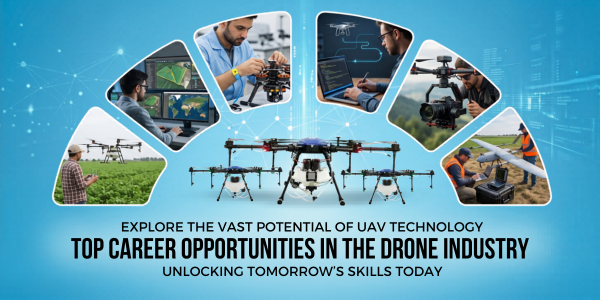
Summary: This article covers the top career paths available in the rapidly growing drone industry. You will learn about the most in-demand drone professions, the skills and certifications needed to enter each field, step-by-step guidance on how to get started, and what earning potential looks like across specializations. Whether you are a beginner or looking to switch careers, this guide maps out every major opportunity available today.
Drone professions are among the fastest-growing career tracks in the world right now, and the window to enter this industry at an early stage is still wide open. From agriculture and construction to cinema and emergency response, trained drone pilots and drone technologists are in high demand across dozens of industries. India alone is witnessing a surge in government-backed drone adoption, DGCA-certified pilot programs, and private sector investment that is creating thousands of new roles every year. If you have been wondering whether a career in drones is worth pursuing, the answer is a clear yes, and this guide will show you exactly where to begin.
1. What Makes Drone Professions One of the Fastest-Growing Career Fields?
Drone professions are growing because industries across the board are replacing slow, expensive, and risky manual processes with fast, affordable, and precise drone-based solutions. The numbers back this up: the global commercial drone market is projected to reach over $54 billion by 2030, with India's own drone sector receiving strong policy support through initiatives like the PLI scheme for drones and the national drone policy framework.
Three forces are driving this growth simultaneously:
- Regulatory clarity has made it easier to legally operate drones for commercial purposes.
- Hardware costs have dropped significantly, making drone deployment accessible for small businesses.
- Demand for aerial data, including imagery, mapping data, crop health reports, and structural inspections, has grown across both public and private sectors.
This combination means that trained drone professionals today are entering a market with more opportunities than qualified pilots to fill them.
2. Commercial Drone Pilot: The Foundational Drone Profession
A commercial drone pilot is the most accessible entry point into the industry. These professionals are hired by businesses, government departments, and private clients to operate drones for a wide range of purposes, from real estate photography to infrastructure monitoring.
How to get started as a commercial drone pilot:
Step 1: Complete a DGCA-approved Remote Pilot Training Organisation (RPTO) course to earn your Remote Pilot Certificate (RPC).
Step 2: Log the required flight hours and pass both theory and practical assessments.
Step 3: Register your drone on the Digital Sky platform and ensure all operations comply with current airspace rules.
Step 4: Build a portfolio of real-world projects across at least two or three industry sectors to strengthen your professional profile.
Step 5: Apply to drone service companies or begin freelancing by pitching to local businesses in real estate, events, and construction.
Commercial drone pilots can work full-time with a company, take on freelance project-based work, or build their own client base over time. This role forms the foundation from which all other drone professions branch out.
Learn more about DGCA-approved drone training programs to understand what certification involves.
3. Aerial Photography and Videography: A Creative Drone Profession
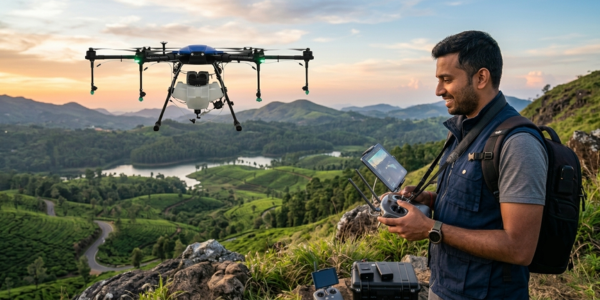
Aerial photographers and videographers use drones to capture cinematic footage for films, OTT platforms, real estate listings, tourism campaigns, weddings, and brand advertisements. This is one of the most visible and creatively rewarding drone professions available.
The role goes beyond flying skills. You need an understanding of camera movement, lighting, framing, and post-production. Pilots who combine technical flight ability with visual storytelling command significantly higher project fees.
Industries that hire aerial videographers:
- Film and television production
- Advertising and brand campaigns
- Wedding and event coverage
The demand for aerial content is growing faster than supply, particularly in Tier 1 and Tier 2 cities in India where real estate development and digital marketing budgets are rising. Explore drone cameras and payload options to understand what equipment professionals use in this space.
4. Agricultural Drone Operator: The High-Impact Drone Profession
Agricultural drone operators, sometimes called Kisan Drone operators, support precision farming across India's vast agricultural landscape. This is currently one of the most government-supported and fastest-hiring drone professions in the country.
Agri-drone pilots perform tasks including crop spraying, NDVI (Normalized Difference Vegetation Index) mapping, soil analysis, pest detection, and yield monitoring. These tasks were previously done manually or not at all, making drone pilots genuinely transformative for farm productivity.
Step-by-step path to becoming an agricultural drone operator:
Step 1: Complete DGCA RPC training with a focus on agri-drone payload operations.
Step 2: Get hands-on training with spray drones, which have specific payload handling and safety requirements.
Step 3: Connect with agri-tech companies, Farmer Producer Organisations (FPOs), and state agriculture departments that actively hire certified operators.
Step 4: Consider specialization in drone-based crop mapping, which adds significant value beyond basic spraying operations.
Government subsidies under the Kisan Drone scheme have made procurement easier for farmers and cooperatives, which is creating a steady pipeline of employment for trained agri-drone professionals.
5. Survey and Mapping Pilot: A High-Value Technical Drone Profession
Drone survey and mapping pilots generate accurate geospatial data used in infrastructure planning, highway construction, railway expansion, smart city projects, and natural resource management. This is among the most technically demanding and highest-paying drone professions.
Professionals in this field use tools like photogrammetry software, RTK (Real-Time Kinematic) drones, and LiDAR sensors to produce orthomosaic maps, 3D terrain models, and precise measurements that inform billion-rupee decisions.
Core skills needed for survey and mapping roles:
- Proficiency in photogrammetry platforms like Pix4D or DJI Terra
- Understanding of GIS (Geographic Information Systems)
- RTK drone operation and ground control point (GCP) placement
- Data accuracy validation and client reporting
Companies in the EPC, mining, and urban infrastructure sectors offer long-term project contracts, making this one of the most stable career options in the drone industry. Check out drone mapping and survey solutions to see how this technology is applied at scale.
6. Infrastructure and Asset Inspection Pilot
Infrastructure inspection is one of the most commercially mature applications for drones. Bridges, transmission towers, solar farms, pipelines, wind turbines, and industrial rooftops all require regular inspection, and drones do this work faster, cheaper, and more safely than manual crews.
Drone inspection pilots work on contract with engineering firms, PSUs, insurance companies, and facility management providers. The role often involves using thermal cameras, zoom lenses, and structured data reporting formats.
Why this drone profession is growing:
- Manual inspection of towers or pipelines poses major safety risks
- Drone inspection reduces inspection time from days to hours
- High-resolution visual data can be fed into AI-based defect detection systems
As infrastructure spending in India grows, the number of companies looking to integrate drone inspections into their maintenance cycles is rising steadily.
7. Public Safety and Disaster Response Drone Pilot
Government agencies and emergency services increasingly deploy drones for search and rescue, flood monitoring, fire assessment, crowd management, and border surveillance. This is among the most mission-critical of all drone professions.
Operators in this field work with police departments, State Disaster Response Forces (SDRF), and civic bodies. The role requires not just flying ability but situational awareness, quick decision-making, and the ability to operate under pressure.
The social impact of this work is significant. During floods or earthquakes, drone pilots have directly contributed to locating survivors in terrain that was inaccessible to ground teams.
8. Drone Instructor and RPTO Trainer
As the number of certified drone pilots grows, so does the need for experienced instructors who can deliver DGCA-aligned training. This is one of the most stable and leadership-oriented drone professions, combining technical expertise with the ability to teach and mentor.
How to qualify as a drone instructor:
Step 1: Accumulate significant flight hours across multiple operational environments.
Step 2: Obtain advanced certifications and, where required, instructor-level DGCA approval.
Step 3: Partner with or join a registered RPTO to deliver structured training programs.
Instructors command consistent income and play a central role in shaping the quality of the next generation of drone pilots across India.
9. Drone Maintenance and Technical Support Specialist
Not every drone career involves active flying. Technical specialists are critical to maintaining fleets, calibrating systems, diagnosing faults, and managing firmware updates. As drone fleets scale up across agriculture, inspection, and delivery companies, the demand for qualified maintenance professionals is rising in parallel.
This role is well-suited to candidates with electronics, electrical engineering, or mechatronics backgrounds. Career paths lead into drone startups, OEM service centers, and large enterprise fleet management operations.
Browse drone technology platforms to get a sense of the hardware ecosystem that maintenance specialists work with.
10. Drone Entrepreneur and Service Provider
Many pilots, after gaining experience across one or more specializations, choose to build their own drone service businesses. This is the highest-risk but also the highest-reward path among all drone professions.
Step-by-step guide to launching a drone service company:
Step 1: Identify a niche, such as agri-drone services, aerial surveys, or media production, based on your experience and regional market demand.
Step 2: Register your business and secure the required UAS operator permits.
Step 3: Build your equipment portfolio starting with one or two mission-critical drone systems.
Step 4: Develop a client acquisition strategy targeting local government bodies, agri-cooperatives, real estate developers, or infrastructure firms depending on your niche.
Step 5: Invest in quality reporting and data delivery workflows, since clients pay for insights, not just flights.
Entrepreneurs in the drone sector benefit from low physical infrastructure costs and the ability to scale quickly by adding certified sub-pilots to their operations.
How to Choose the Right Drone Profession for You
The right drone profession depends on three factors: your existing skills and background, your income expectations, and the type of work you find motivating.
Drone Profession | Best For | Entry Barrier |
Commercial Pilot | Generalists, flexible workers | Low |
Aerial Videography | Creative professionals | Medium |
Agri-Drone Operator | Rural, field-oriented workers | Low |
Survey and Mapping | STEM / GIS backgrounds | Medium-High |
Inspection Pilot | Engineering background | Medium |
Instructor | Experienced pilots | High |
Entrepreneur | Business-minded pilots | High |
Regardless of which path you choose, DGCA certification is the non-negotiable starting point. Without it, commercial drone operations in India are not legally permissible.
Final Thoughts on Building a Career in Drone Professions
The drone industry in India is no longer in a pilot phase. It is operational, regulated, and growing at a pace that is creating genuine, well-paying, long-term careers. Drone professions span creative, technical, agricultural, governmental, and entrepreneurial domains, which means there is a viable path for nearly any background or skillset.
The key is to start with proper certification, build real-world flying experience, and then specialize in a sector where your existing strengths give you an edge. Explore drone career resources and training pathways to take the first concrete step toward entering this industry.
The best time to enter the drone profession was two years ago. The second best time is today.