Types of drones categories classification gives buyers, pilots and businesses a clear way to compare unmanned aircraft before spending money or applying for permissions. Drones differ in structure, weight, power source, range and purpose, so one model rarely fits every task. In India, classification also decides which rules apply, what pilot training is needed and whether a type certificate is required. So before we go deeper, which job do you want your drone to do first?
Quick Summary: This guide explains types of drones categories classification by structure, weight, use, range, autonomy and power source. It covers the five DGCA weight classes used in India and shows what a type certified drone is. You will also get a six step checklist to pick a compliant drone for your job. Read on to compare drone types and avoid costly buying mistakes.
1. What Is Types of Drones Categories Classification and Why Does It Matter?
Types of drones categories classification is the method of grouping unmanned aircraft by shared traits such as structure, weight, range, power source, autonomy and mission. It matters because every group comes with different strengths, costs and legal duties. A small multirotor suits photography, while a fixed-wing model suits long mapping routes. Knowing the group before you buy helps you avoid paying for features you will never use.
The most common classification methods are:
- By structure: multirotor, fixed-wing, single-rotor and hybrid VTOL
- By weight: nano, micro, small, medium and large
- By use: agriculture, industrial, security, defence and recreation
- By control: remotely piloted, semi-autonomous and fully autonomous
- By power source: battery, gasoline, hydrogen fuel cell and solar
Which of these matters most for your project: range, payload or ease of use?
2. How Does Types of Drones Categories Classification Work by Structure?
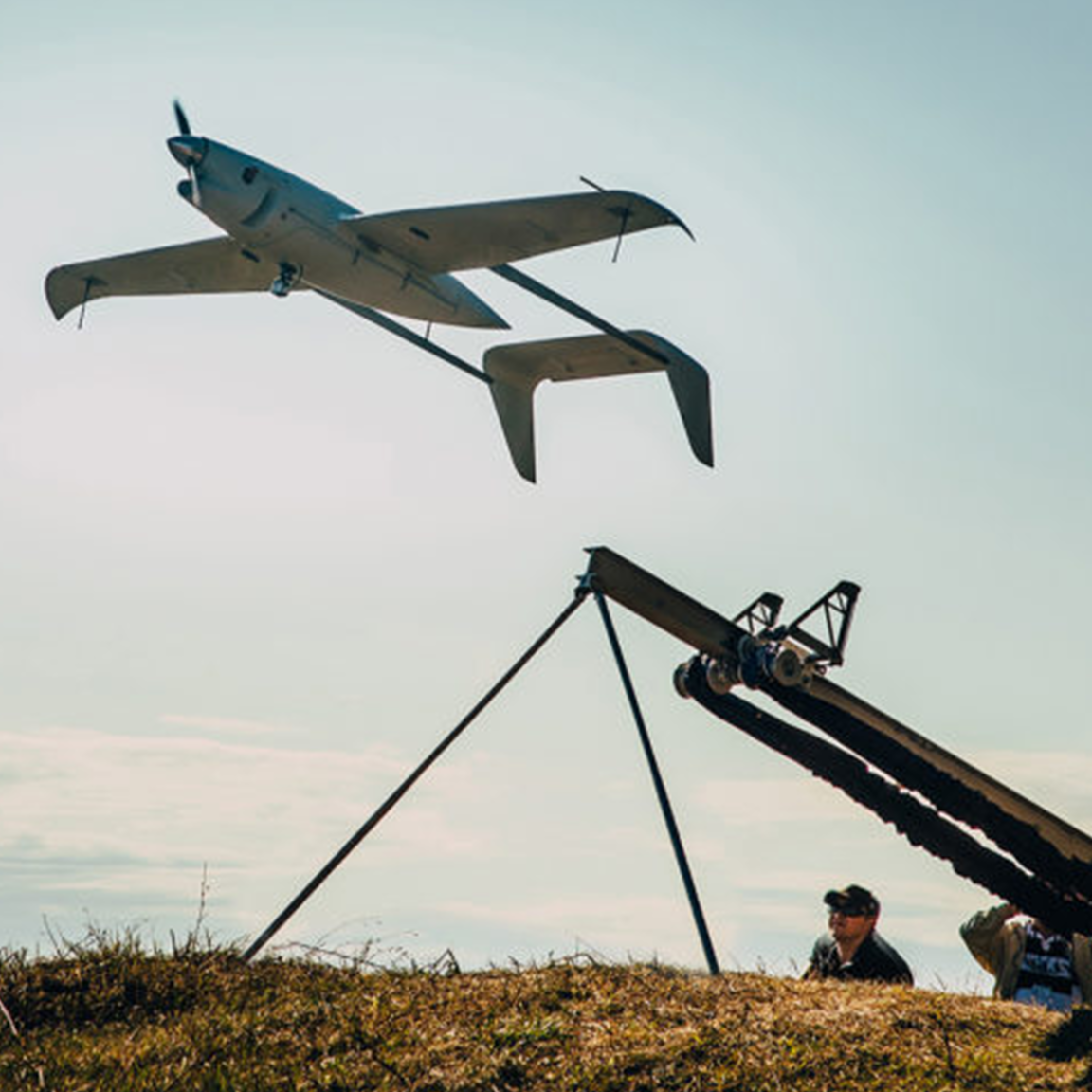
Structure is the first and simplest way to sort drones, because it decides how a drone creates lift and how long it can stay in the air. Multirotor drones use several propellers and hover easily, while fixed-wing drones glide on wings and cover far more ground on one battery. Hybrid VTOL drones combine both ideas. The table below compares the four main structures.
Drone Structure | How It Flies | Key Strength | Main Limitation | Typical Use |
Multirotor | Lift from several propellers | Hovering and easy control | Short flight time | Photography, inspection |
Fixed-wing | Lift from wings in forward flight | Long range and endurance | Needs space to launch and land | Large area mapping, surveillance |
Single-rotor | One main rotor and a tail rotor | Heavy payload, long endurance | Costly and harder to fly | LiDAR scanning, heavy lifting |
Hybrid VTOL | Vertical takeoff, then wing lift | Range plus no runway needed | Complex and expensive | Pipelines, power lines, rescue |
Multirotors are also split by arm count. Quadcopters have four arms and are the most common type. Hexacopters have six arms and can still land safely if one motor fails. Octocopters have eight arms and lift heavier cameras, but they are larger and harder to handle in tight spaces.
3. What Are the DGCA Weight Classes in Types of Drones Categories Classification?
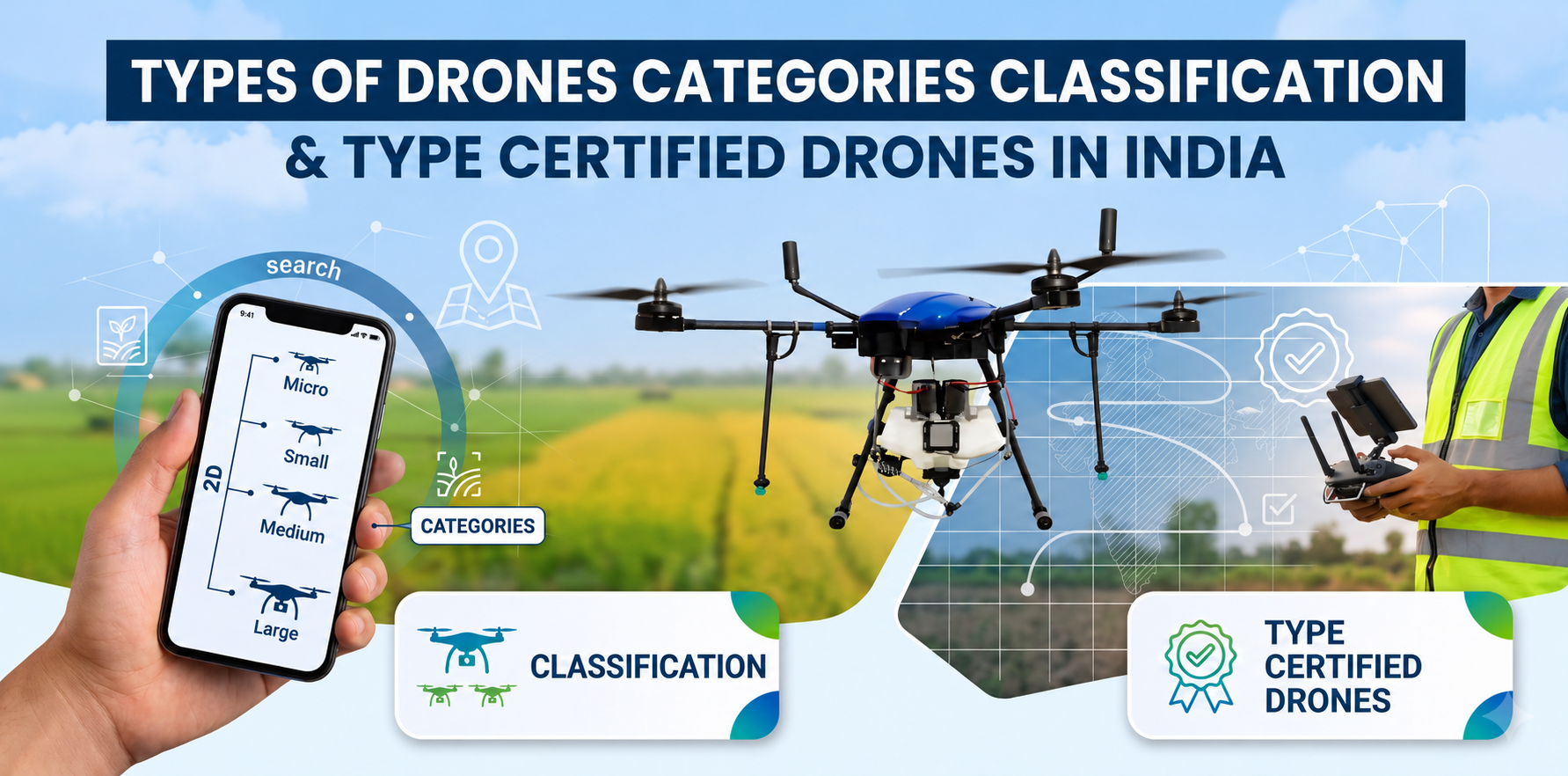
India's Drone Rules 2021 place every drone in one of five weight classes, and the class decides the compliance burden. A heavier drone usually means more paperwork, stricter pilot rules and higher risk. The classes are listed below with the kind of work each one commonly does.
Class | Weight Range | Common Use |
Nano | Up to 250 g | Toys, learning, short indoor flights |
Micro | Above 250 g up to 2 kg | Photography, close range inspection |
Small | Above 2 kg up to 25 kg | Mapping, spraying, surveying |
Medium | Above 25 kg up to 150 kg | Industrial work, heavy payloads |
Large | Above 150 kg | Cargo, long endurance missions |
Weight also affects pilot licensing. In general, a remote pilot certificate is needed for commercial flying, with relaxations for nano and non-commercial micro drones. If buying and managing a fleet feels like too much, many businesses now hire drone as a service providers instead. This gives them flight data and results without owning the aircraft.
4. How Does Types of Drones Categories Classification Work by Use?
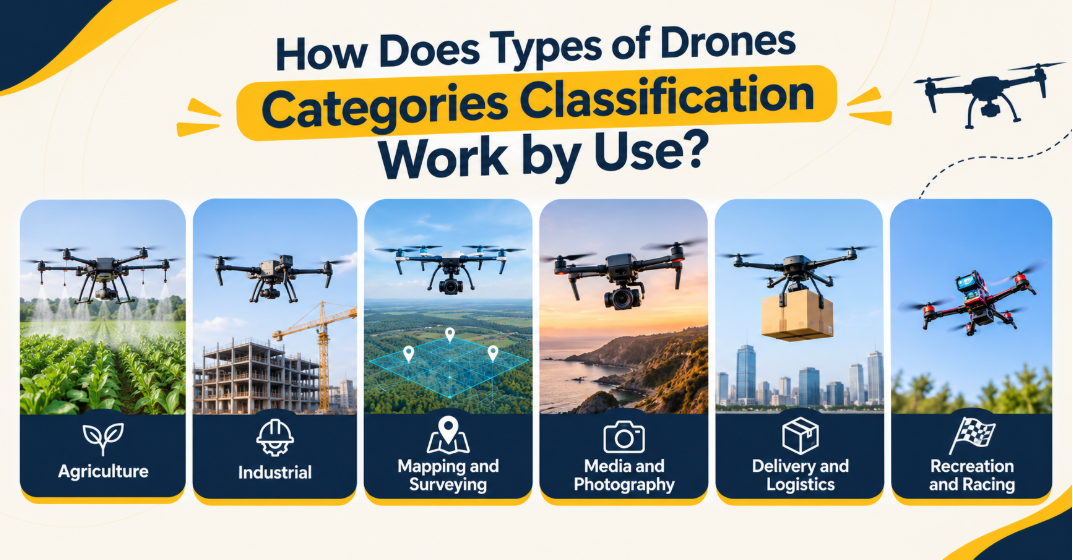
Use based classification groups drones by the job they perform, and it is the most practical method for buyers because it starts with the outcome. Each sector prefers certain structures, payloads and sensors. Here are the main categories and what they do best.
- Agriculture: Crop monitoring, precision spraying and field mapping. Precision agriculture drones save time, water and labour on large farms.
- Industrial: Inspection of towers, solar plants, pipelines and construction sites. Industrial drones reach places that are risky for people.
- Mapping and surveying: Orthomosaics, 3D models and elevation data for GIS and planning teams.
- Media and photography: Films, events, real estate and journalism shoots.
- Delivery and logistics: Light cargo to remote or hard to reach locations.
- Recreation and racing: Hobby flying and FPV competitions on approved land.
Do you plan to fly for work, for farming or purely for fun? Your answer narrows the list quickly.
5. What Other Types of Drones Categories Classification Methods Should You Know?
Beyond structure, weight and use, drones are also classified by range, autonomy and power source, and these three methods explain performance limits. Range tells you how far a drone can fly from its controller. Autonomy tells you how much a pilot must do. Power source decides flight time and noise. The table gives a quick view.
Method | Categories | Quick Note |
Range | Very close (under 5 km), close (5 to 50 km), short (50 to 150 km), medium (150 to 650 km), long (over 650 km) | Longer range needs stronger links and approvals |
Autonomy | Remotely piloted, semi-autonomous, fully autonomous | Autonomous drones follow programmed routes |
Power source | Battery, gasoline, hydrogen fuel cell, solar | Battery is most common, fuel gives longer flights |
Large, long endurance platforms used in national security often fall in the higher altitude groups such as MALE and HALE. Defense drones sit in this segment and follow separate procurement and safety standards from civil models.
6. What Are Type Certified Drones in India?
A type certified drone is a drone model whose design has been tested and approved against standards set by the Indian aviation regulator. Under the Drone Rules 2021, the Directorate General of Civil Aviation issues the certificate after testing by the Quality Council of India and its authorised testing entities. The certificate confirms that the model meets safety, build quality and flight control requirements.
Certification is generally not required for nano drones or models built only for research and development, but most other commercial drones need it. Always check the latest DGCA and Digital Sky notifications before you buy, because rules are updated often.
Why does a type certificate matter? Here are the main benefits:
- Legal registration and a unique identification number
- Safer flights through tested hardware and software
- Easier approvals for commercial operations
- Better insurance and customer trust
- Lower risk of grounded or rejected equipment
Commercial pilots also need a remote pilot certificate from a DGCA approved organisation. Enrolling in remote pilot training covers classroom learning, simulators and real flight practice.
7. How Do You Choose the Right Type Certified Drone? (Step by Step)
You choose the right type certified drone by working through six clear steps, starting with the job and ending with ownership. Follow them in order to avoid compliance surprises.
Step 1: Define the job. Write down the task, such as crop spraying, tower inspection or crowd monitoring. For patrolling and surveillance, review safety and security drone solutions to see how real operations are structured.
Step 2: Match the weight class. Pick the lightest class that can carry your payload, since lighter drones face fewer rules.
Step 3: Pick the structure. Choose multirotor for hovering, fixed-wing for large areas and hybrid VTOL for long routes without a runway.
Step 4: Verify the type certificate. Ask the seller for proof of DGCA type certification and check that the model is registered.
Step 5: Plan pilot training and airspace. Complete remote pilot certification and check the green, yellow and red zones on the Digital Sky airspace map.
Step 6: Compare buying with hiring. Calculate the cost of ownership, batteries, insurance and training against a service contract.
8. Frequently Asked Questions About Types of Drones Categories Classification
Which is the most common drone type? The quadcopter is the most common because it is stable, affordable and easy to fly.
Do all drones in India need a type certificate? Most commercial drones do, with exceptions for nano drones and research models. Confirm current rules on the DGCA website.
What is the best drone for long distance mapping? A fixed-wing or hybrid VTOL drone is usually best because it flies longer on a single battery.
Final Thoughts
Types of drones categories classification turns a confusing market into a simple decision map. Start with the job, match the weight class, choose the right structure and confirm the type certificate before you fly. Do that, and you will stay compliant, safe and productive. Which drone category fits your next project? Share your use case and we will help you narrow it down.