What happens if you fly drone without license in India is a question more people need to be asking before they launch. With drone technology becoming increasingly accessible and affordable, many operators assume that flying a drone is as simple as unboxing it and pressing takeoff. It is not. India's Drone Rules 2021 impose clear, enforceable obligations on drone operators -- and violating them carries real consequences including financial penalties, confiscation of equipment, criminal charges, and permanent bans from commercial drone operations. This guide covers every consequence of unlicensed drone flying in India, which categories require a license, and how to get compliant before your first commercial flight.
1. What Happens If You Fly Drone Without License: The Short Answer
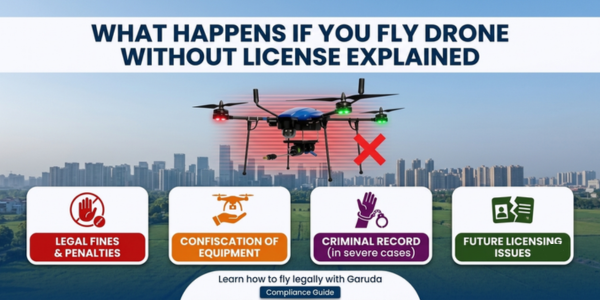
Flying a drone without a license in India is illegal for any commercial operation involving a drone above 250 grams, and it is enforceable. The DGCA (Directorate General of Civil Aviation) has the authority to impose fines of up to Rs 1,00,000, confiscate unregistered or unlicensed drones, initiate criminal proceedings under the Indian Penal Code, and permanently suspend an operator's ability to obtain future permissions.
Are you currently flying a drone commercially without a Remote Pilot Certificate? You are operating outside the law, exposing yourself to financial liability, equipment loss, and in serious cases criminal prosecution. The risk is not theoretical -- enforcement of drone regulations in India has been steadily increasing alongside the industry's growth.
2. Do You Actually Need a License to Fly a Drone in India?
Not every drone operator in India needs a license -- it depends entirely on the drone's weight and how it is being used. Under the Drone Rules 2021:
Drone Category | Weight | License Required? |
Nano | Up to 250 grams | No (non-commercial, green zones only) |
Micro | 250 grams to 2 kg | Yes (for commercial use) |
Small | 2 kg to 25 kg | Yes (all operations) |
Medium | 25 kg to 150 kg | Yes (all operations) |
Large | Above 150 kg | Yes (all operations) |
Even Nano drones, which do not require a license, cannot be flown above 50 feet, faster than 25 metres per second, in red zones, near airports, over crowds, or in controlled airspace. Violating these restrictions with a Nano drone still carries penalties -- the license exemption does not exempt operators from all rules.
The critical threshold is this: any commercial drone operation above 250 grams requires a Remote Pilot Certificate (RPC) from the DGCA. "Commercial" means any operation where the drone is used for a paid service, business purpose, or professional deliverable -- including photography, videography, agriculture, survey, inspection, and delivery.
3. What Are the Specific Penalties for Flying Without a License?
3.1. Financial Fines
Financial penalties for unlicensed drone operations in India can reach up to Rs 1,00,000 per violation. The exact fine depends on the nature and severity of the violation:
- Minor violations (flying in a green zone without registration): Lower end of the penalty scale
- Serious violations (flying in restricted areas, near airports, or over crowds without authorisation): Higher penalties, potentially escalating with multiple incidents
- Commercial operations without RPC: Treated as a serious violation affecting public safety and airspace security
Fines are assessed per incident, which means that multiple flights without a license can result in cumulative penalties that far exceed the cost of obtaining proper certification.
3.2. Drone Confiscation
Authorities can seize any unregistered drone or drone being operated without proper licensing. Once confiscated, recovery of the equipment requires going through a formal legal or administrative process that can take considerable time. There is no guarantee of return even after paying fines, particularly if the drone was used in a serious violation.
For operators who have invested Rs 5 to 15 lakh or more in professional agricultural spraying or survey equipment, confiscation is a catastrophic financial consequence that dwarfs the cost of obtaining proper certification.
3.3. Criminal Charges
In serious cases -- including surveillance of sensitive areas, flying near military installations, or operations that pose genuine risk to public safety or other aircraft -- unlicensed drone operation can result in criminal charges under the Indian Penal Code. These charges can lead to imprisonment, not just financial penalties.
The most serious scenarios that trigger criminal proceedings include:
- Flying near airports without clearance (endangering manned aviation)
- Operating in red zones (military bases, nuclear facilities, sensitive government complexes)
- Using a drone for illegal surveillance or privacy violations
- Causing property damage or personal injury through negligent operation
3.4. Suspension and Permanent Bans
Repeated violations or serious first-time offences can result in suspension of the operator's ability to obtain future DGCA permissions. For entrepreneurs or professionals building a drone service business, this is career-ending. The DGCA maintains records of violations, and a history of non-compliance makes it significantly harder to obtain future approvals including BVLOS operational clearances that the industry is moving toward.
3.5. Insurance Invalidation
Insurance policies for drone operations in India require proof of valid licensing and registration. If an incident occurs during an unlicensed operation -- whether property damage, personal injury, or third-party liability -- the insurance policy will not pay out. The operator bears full personal financial responsibility for all damages. For an agricultural drone that malfunctions and damages a crop or injures a farm worker, this exposure can be substantial.
3.6. Commercial Disqualification
Unlicensed operators cannot legally bid for or execute government or large corporate drone service contracts. As India's drone services market matures, enterprise clients and government programmes including NAMO Drone Didi, the SVAMITVA land mapping scheme, and large-scale agricultural spraying programmes all require documented operator certification before awarding work. Operating without a license permanently closes off these high-value commercial opportunities.
4. What Happens If You Fly Drone Without License in Specific Scenarios?
4.1. Agricultural Drone Spraying Without License
Flying an agricultural spraying drone -- a Small category platform typically carrying 10 to 30 litres of pesticide -- without a Remote Pilot Certificate is a serious regulatory violation. Beyond the DGCA penalty, agricultural spraying without DGCA certification also violates CIB&RC (Central Insecticides Board and Registration Committee) chemical application requirements. The combined exposure includes DGCA fines, potential agricultural department action, and full personal liability for any crop or environmental damage caused by the unlicensed operation.
For farmers and agri-entrepreneurs considering precision agriculture services using drones, the regulatory pathway is straightforward: certification before commercial operation protects both the operator and the clients they serve.
4.2. Aerial Photography and Videography Without License
Drone photography and videography is one of the most common contexts where operators underestimate licensing requirements. Many photographers assume that if they are not flying "commercially" they do not need a license. Any paid drone photography job -- real estate, weddings, events, corporate content -- is a commercial operation. Any drone above 250 grams used for a paid job requires an RPC. DGCA enforcement increasingly focuses on this category because unlicensed aerial photographers are highly visible on social media and at events.
4.3. Survey and Mapping Without License
Survey and mapping operations using drones above 250 grams require full DGCA certification. This applies to construction site surveys, topographic surveys for infrastructure projects, soil mapping and nutrient analysis for agricultural clients, and land record mapping. Unlicensed survey operations create additional risk because the data produced cannot be used in legal, regulatory, or engineering contexts without a certified chain of custody from a licensed operator.
4.4. Drone Delivery Without License
Drone delivery -- a rapidly growing sector in India -- requires a Remote Pilot Certificate plus additional approvals for the specific operational scenario. Operating delivery drones without certification exposes operators to the full range of DGCA penalties plus potential liability for damaged or undelivered goods.
4.5. Flying Near Sensitive Areas Without Authorisation
This is the category with the most severe consequences. Flying near airports, within 25 km of international borders, over military installations, or near government complexes without explicit authorisation is illegal regardless of whether the operator holds a license. Even licensed operators who fly in these areas without the required permissions from ATC, the Ministry of Defence, or other relevant authorities are in violation. For unlicensed operators, the penalties are compounded.
5. How Does the DGCA Detect Unlicensed Drone Operations?
5.1. NPNT Enforcement
The No Permission, No Takeoff (NPNT) system is the most powerful enforcement mechanism in India's drone regulatory framework. DGCA-compliant drones cannot physically take off without receiving a digital clearance from the Digital Sky Platform. This means that operating a compliant drone without proper registration and RPC results in the drone literally being unable to launch -- the hardware-level enforcement prevents the violation before it occurs.
Non-compliant drones (typically older models, imported drones without NPNT firmware, or illegally modified platforms) can bypass this system -- but operating such drones is itself a violation that adds to the penalty exposure.
5.2. Public Reports and Social Media
India's growing drone awareness means that unlicensed operations -- particularly in visible locations -- are increasingly being reported by members of the public. High-profile events, real estate projects, and visible commercial drone operations attract attention, and reports to DGCA or local law enforcement are a realistic enforcement trigger.
5.3. Airport and Airspace Monitoring
Airports and major airspace monitoring systems detect unauthorised drone activity through radar, RF detection, and optical surveillance systems. Near-miss incidents involving commercial aircraft and unregistered drones trigger immediate enforcement action and can escalate to criminal investigation regardless of the operator's intent.
5.4. Routine Inspection and Compliance Checks
DGCA and law enforcement agencies conduct compliance checks at events, construction sites, and agricultural operations where drone use is common. Operators who cannot produce a valid RPC and registered drone documentation at the point of operation are subject to on-the-spot enforcement.
6. What Happens If You Fly Drone Without License vs With License: A Direct Comparison
Factor | Without License | With License |
Legal status | Illegal (commercial ops, drones above 250g) | Fully compliant |
Financial exposure | Fines up to Rs 1,00,000 per violation | None for compliant operations |
Equipment risk | Confiscation | Protected |
Insurance | Invalid | Valid |
Criminal liability | Possible in serious cases | Not applicable for compliant ops |
Commercial opportunities | Blocked | Full access |
Future permissions | Jeopardised | Clean record |
Client credibility | Zero | High |
Government contracts | Ineligible | Eligible |
The comparison is not close. The cost of obtaining a Remote Pilot Certificate -- typically Rs 35,000 to Rs 90,000 including a 5-day DGCA-approved training programme -- is a fraction of the financial, legal, and reputational cost of a single serious enforcement action.
7. How to Get Licensed and Avoid All These Consequences
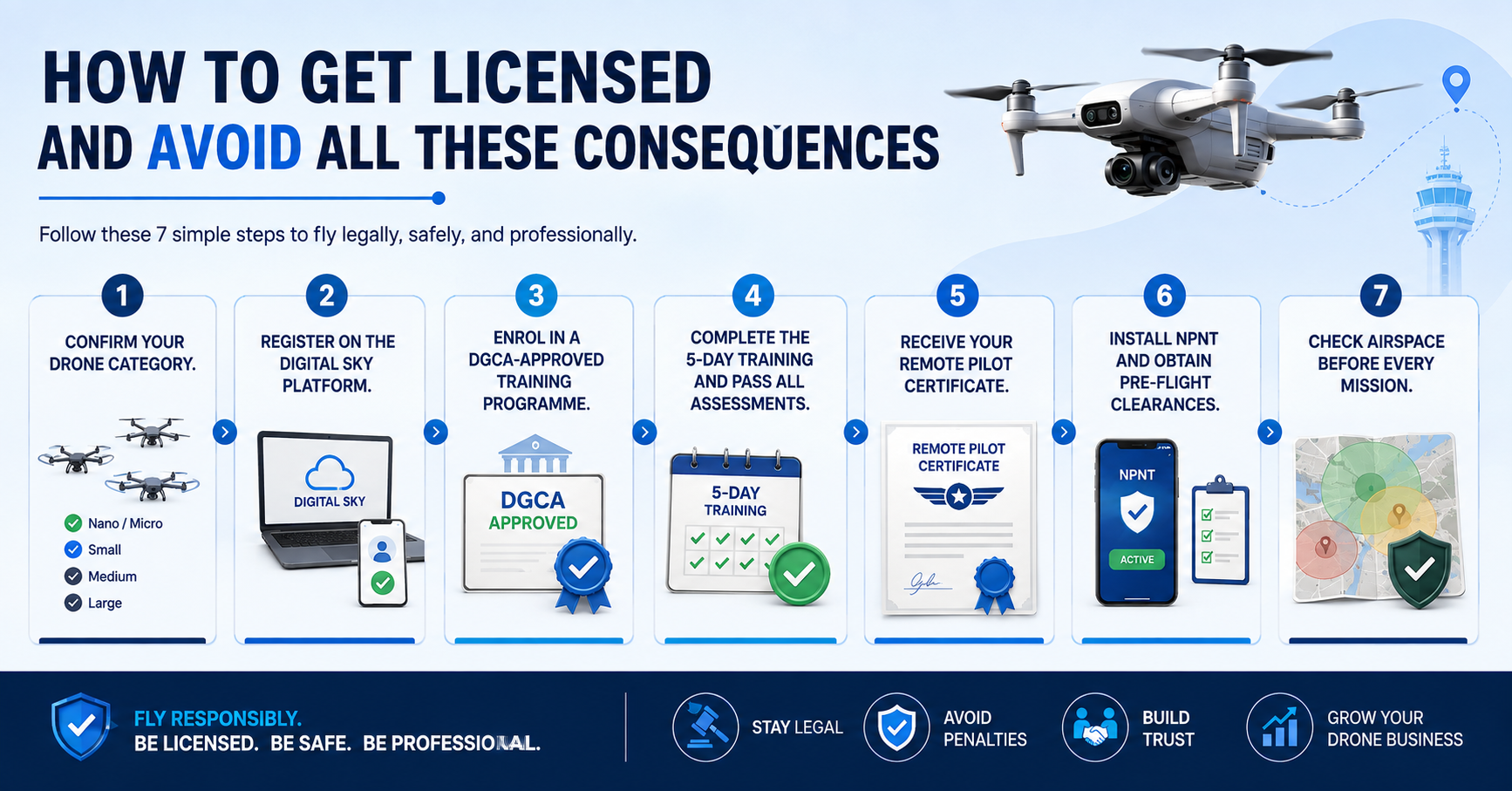
The solution to every consequence described in this article is simple: get certified before you fly commercially.
Step 1 -- Confirm your drone category. If your drone weighs above 250 grams and you are using it for any commercial purpose, you need a Remote Pilot Certificate. Check your drone's all-up weight including camera, battery, and any payload.
Step 2 -- Register on the Digital Sky Platform. Visit digitalsky.dgca.gov.in, create an account, and register your drone to obtain a Unique Identification Number (UIN). This is mandatory for all drones above 250 grams before any commercial operation.
Step 3 -- Enrol in a DGCA-approved training programme. Only institutions officially listed as RPTOs on the Digital Sky Platform can issue certification that the DGCA recognises. Verify RPTO status before paying any fees. DGCA-approved drone pilot training programmes cover all regulatory knowledge, practical flying skills, and examination preparation needed to pass.
Step 4 -- Complete the 5-day training and pass all assessments. The standard RPC course for Small category rotorcraft runs 5 days covering ground school theory, simulator practice, and live flying. You must pass a theory test, simulator test, and practical flying assessment to obtain your RPC.
Step 5 -- Receive your Remote Pilot Certificate. On successful completion of all assessments, the DGCA issues your RPC digitally through the Digital Sky Platform within 15 working days. Your certificate is valid for 10 years.
Step 6 -- Install NPNT and obtain pre-flight clearances. Install the NPNT application on your mobile device. Before every commercial flight, submit a flight permission request through the Digital Sky Platform and wait for approval before launching. This is mandatory for every individual flight.
Step 7 -- Check airspace before every mission. Use the Digital Sky Platform's interactive airspace map to confirm you are operating in a green zone or have obtained the required ATC permission for yellow zone operations. Never fly in red zones without explicit Central Government permission.
8. Who Is Most at Risk of Flying Without License?
Agricultural drone operators using service providers. Farmers who hire a drone spraying service must ensure the service provider holds a valid RPC and operates a registered drone. If the service provider is unlicensed, the farmer may share liability for the unlicensed operation on their land. Verify credentials before authorising any drone operation on your farm.
Photography and media professionals new to drones. Experienced photographers who transition to drone work often underestimate the regulatory requirements, assuming their professional status or existing camera licenses provide some coverage. They do not.
Construction and survey companies using drones for the first time. Companies that deploy drones for site survey, progress monitoring, or crop health monitoring and disease and pest detection without verifying operator certification are exposed to the same penalties as the unlicensed pilot.
Hobbyists who transition to paid work. A hobbyist who begins accepting payment for drone photography immediately transitions from recreational to commercial status -- and all the licensing requirements that brings.
9. The Long-Term Cost of Non-Compliance
The financial penalty for flying without a license is the most visible consequence, but the long-term career and business cost is often greater. A violation record with the DGCA can:
- Block access to future BVLOS operational approvals as the sector scales
- Disqualify operators from government programmes including agricultural subsidy-linked drone service contracts
- Prevent participation in large enterprise contracts that require documented operator credentials
- Create reputational damage with clients and agricultural cooperatives who increasingly verify operator credentials before awarding work
The drone industry in India is growing at 20 to 24% CAGR and is projected to reach Rs 30,000 crore in the next few years. The operators who build clean compliance records today will have the strongest position to capture the largest share of this growth. Those who start unlicensed and get caught will find themselves starting over -- at best.
Final Thoughts
What happens if you fly drone without license in India is not a grey area. Financial penalties, equipment confiscation, criminal liability, insurance invalidation, commercial disqualification, and long-term enforcement history are all real, documented consequences under India's Drone Rules 2021. The regulatory framework is designed not to harass operators but to ensure safe, accountable drone operations across one of the world's busiest and most diverse airspaces.
The cost of compliance is modest and the process is accessible. Enrolling in a DGCA-certified training programme, obtaining your Remote Pilot Certificate, and registering your drone properly takes less than two weeks and costs a fraction of what a single enforcement action would cost. Whether you are planning to offer precision agriculture drone services, survey and mapping, media production, or any other commercial application, the path to legal operation is clear and straightforward.