A long range drone is one of the most strategically important categories of unmanned aerial vehicle in the modern world, capable of flying 50 to 300 kilometres on a single mission while transmitting real-time data, video, and intelligence back to a ground station. Unlike standard consumer or prosumer drones that are optimised for photography, recreation, or short-range commercial tasks, long range UAVs are engineered for missions where coverage distance, endurance, and communication link reliability are the primary design requirements. In India, the demand for capable long range platforms is growing rapidly across defence and border security, maritime surveillance, infrastructure inspection, agricultural monitoring, and disaster response -- all sectors where the ability to reach distant, remote, or inaccessible locations without risking personnel is a core operational requirement.
What you will learn in this article:
- What a long range drone is and how it differs from standard consumer UAVs
- What specifications define long range capability in the Indian and global context
- What technologies enable extended flight range and endurance
- How long range drones are used across defence, agriculture, infrastructure, and disaster response in India
- What regulations apply to BVLOS long range operations in India in 2026
1. What Is a Long Range Drone and How Is It Defined?
A long range drone is defined by its ability to operate beyond the standard Visual Line of Sight (VLOS) boundary, with an operational radius typically starting at 50 kilometres from the ground control station. In global aviation terminology, "long range" spans a wide spectrum -- from 15 km consumer models to intercontinental military systems. In the Indian context, a platform with a 50 km or greater operational radius is generally considered long range, because this threshold places the aircraft squarely in BVLOS (Beyond Visual Line of Sight) territory.
It is important to distinguish between range and endurance, because they are related but not identical. Range refers to how far a drone can fly while maintaining reliable command and control. Endurance is how long the drone can stay airborne. A platform can have impressive transmission range but poor endurance if the battery dies before reaching the intended distance -- conversely, excellent endurance means little if the communication link fails at 30 km.
Quick reference specifications for long range drones:
Specification | Entry Level | Professional | Strategic/Defence |
Operational radius | 50 to 80 km | 80 to 150 km | 150 to 300+ km |
Flight endurance | 2 to 3 hours | 3 to 8 hours | 8 to 24+ hours |
Payload capacity | 1 to 5 kg | 5 to 25 kg | 25 to 200 kg |
Platform type | Extended multirotor or small VTOL | Hybrid VTOL or fixed-wing | MALE/HALE fixed-wing |
2. What Are the Types of Long Range Drones?
2.1. Fixed-Wing Long Range Drones
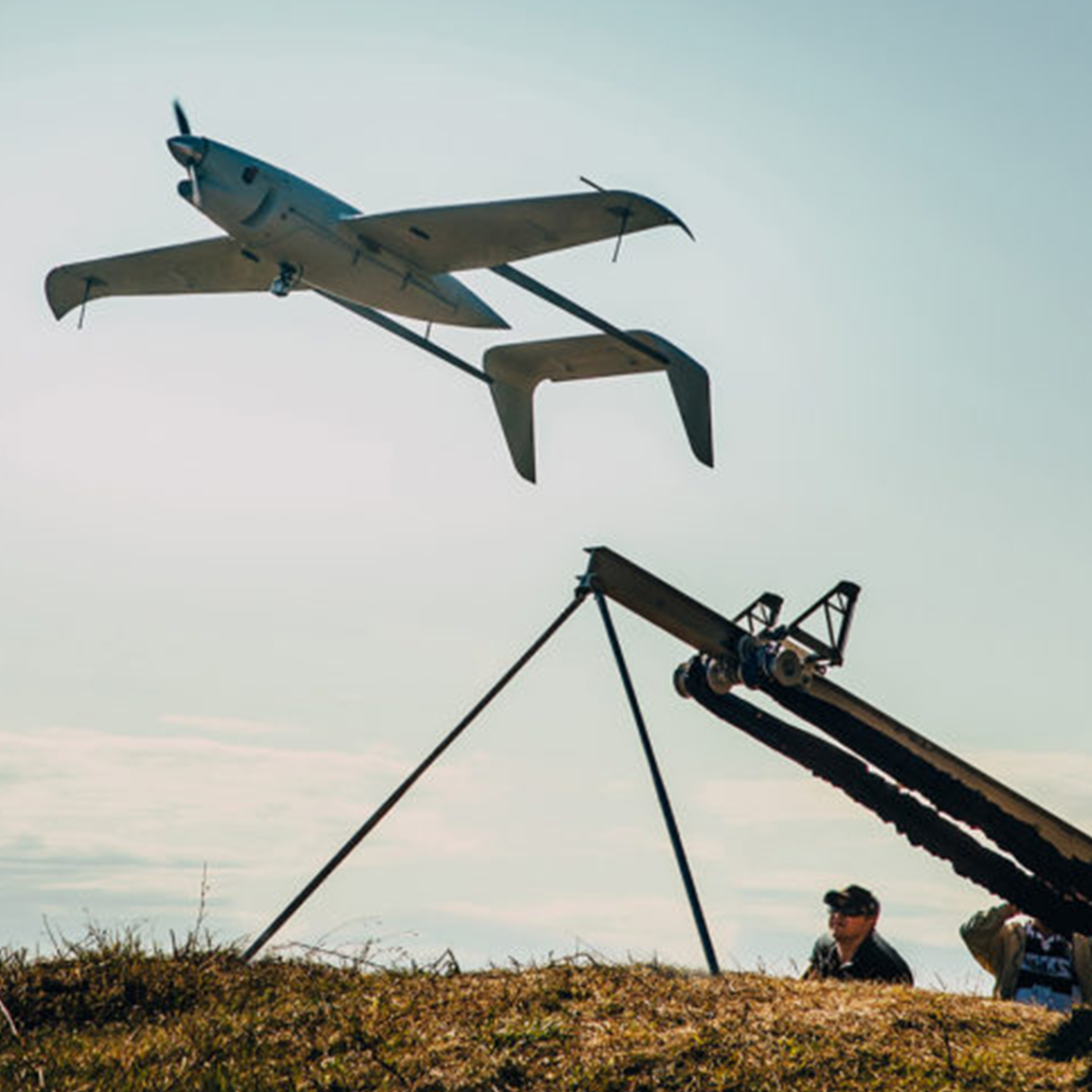
Fixed-wing drones dominate the long range category because wings generate lift far more efficiently than rotors. A well-designed fixed-wing UAV with a 3 to 4 metre wingspan can stay airborne for 8 to 20 hours, covering hundreds of kilometres at cruise speeds of 80 to 150 km/h. These platforms are the backbone of long range surveillance operations in India, used by military forces and border security agencies for persistent area monitoring along the LoC and LAC.
The primary limitation of fixed-wing platforms is runway dependency. They need either a prepared runway or a catapult launcher for takeoff and a recovery system for landing, which restricts deployment to prepared sites. In remote forward operating bases or disaster-affected terrain, this is often impractical. Despite this constraint, fixed-wing platforms remain the gold standard for missions where endurance and range are the overriding requirements.
2.2. Hybrid VTOL Long Range Drones
Hybrid VTOL (Vertical Takeoff and Landing) drones solve the runway problem by combining multirotor lift motors with a fixed-wing cruise configuration. The aircraft takes off vertically, transitions to wing-borne flight for the cruise phase, and transitions back to hover for precision landing -- without any runway infrastructure. This architecture delivers approximately 70 to 85 percent of the endurance of a comparable pure fixed-wing platform, while offering the operational flexibility to launch from confined spaces, rooftops, or ship decks.
Hybrid VTOL platforms are increasingly favoured for both military long range drone deployments and civilian BVLOS operations in India, because they bridge the gap between the operational flexibility of multirotors and the coverage efficiency of fixed-wings. For precision agriculture survey missions, infrastructure corridor inspections, and border surveillance in difficult terrain, hybrid VTOL represents the most versatile long range architecture currently available.
2.3. Extended-Range Multirotors
Standard multirotor drones are limited to 30 to 45 minutes of flight on lithium-polymer batteries, which significantly constrains their effective range. However, advances in battery chemistry, hydrogen fuel cells, and hybrid petrol-electric generators are pushing certain multirotors into genuine long range territory. Platforms with high-density lithium-ion battery packs, optimised low-KV motors, and large-diameter propellers can achieve 1.5 to 3 hours of flight, extending effective range to 40 to 80 km.
For agricultural applications including soil mapping and nutrient analysis and crop health monitoring across large farm areas, extended-range multirotors offer the manoeuvrability and sensor flexibility of standard agricultural drones with meaningfully longer operational windows between battery changes.
3. What Technologies Enable Long Range Drone Flight?
3.1. Propulsion and Power Systems
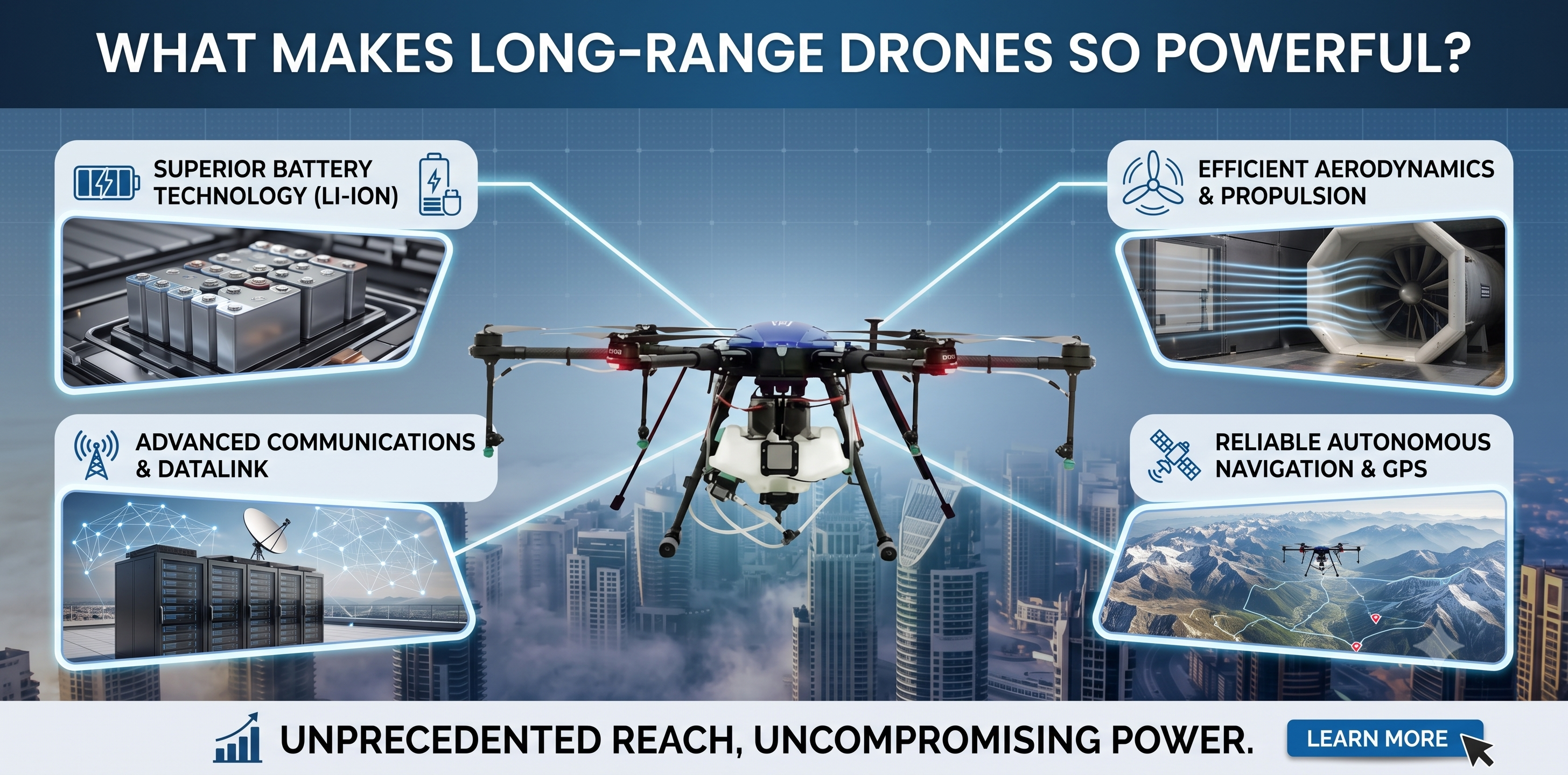
The power system is the foundation of any long range drone's capability. Battery capacity sets the ceiling for endurance, but battery weight determines how much that ceiling costs in terms of reduced payload and manoeuvrability.
Key propulsion technologies for long range drones:
- Lithium-ion (Li-Ion) batteries -- Higher energy density per gram than standard LiPo batteries; the preferred choice for endurance-focused long range missions. They deliver softer throttle response but significantly longer flight times.
- Lithium-polymer (LiPo) batteries -- Higher power delivery rate than Li-Ion; preferred when aggressive manoeuvring or heavy payload lift is required alongside range.
- Hybrid petrol-electric systems -- Combining a small combustion engine as a generator with electric motors; can extend endurance to 4 to 8 hours on multirotors where battery swaps are impractical.
- Hydrogen fuel cells -- The next frontier for long range endurance; produce electricity through a chemical reaction between hydrogen and oxygen, emitting only water. They can support 2 to 4 hour flight times at significant payload weights, and are being actively developed for agricultural and logistics applications.
3.2. Airframe Efficiency
The airframe determines how efficiently the propulsion system converts energy into forward flight. For long range drones, aerodynamic efficiency is as important as raw power capacity.
Fixed-wing designs convert energy into lift through wing area, requiring far less continuous power than rotors to maintain altitude and forward speed. For equivalent payload and endurance at 120 km/h cruise, a fixed-wing platform typically uses 60 to 75 percent less power per kilometre than a multirotor. For extended-range multirotors, low-KV motors paired with large-diameter, slow-turning propellers approach similar efficiency at lower speeds, making them practical for agricultural survey and inspection tasks.
3.3. Communication Links
The communication link is the lifeline of any long range drone. When operating at 50 to 300 km from the ground station, maintaining reliable command and control and data transmission is a critical engineering challenge. In India, operators face additional complexity from terrain masking in mountainous regions, electromagnetic interference in border zones, and spectrum allocation rules.
Primary communication architectures for long range drone India operations:
Link Type | Range | Best Application |
SATCOM (Ku/Ka-band) | Near-global | Ranges above 100 km; defence and maritime surveillance |
Dedicated radio (L/S/C-band) | Up to 150 km (line of sight) | Defence and inspection with directional antennas |
Mesh relay networks | Scalable with nodes | Tactical formations and BVLOS corridors |
4G/5G cellular | Variable (network-dependent) | Urban BVLOS in populated corridors |
Hybrid architectures | Varies by combination | Most professional long range deployments |
Mesh communication systems create a resilient, self-healing network between drones and ground stations, enabling reliable data and command links even in RF-contested or terrain-masked environments -- particularly valuable for military long range drone operations near India's northern borders.
3.4. Navigation and Autonomy
Long range drone platforms must navigate accurately over extended distances, often through terrain where GPS quality varies or where adversarial jamming is a risk. Modern long range UAVs use:
- Dual GNSS receivers (GPS plus GLONASS or India's NavIC) for redundant positioning
- Inertial Navigation Systems (INS) for position maintenance in GNSS-denied environments
- Waypoint-based autonomous flight enabling pre-programmed missions with minimal operator intervention during the cruise phase
- Return-to-home (RTH) protocols that bring the drone back safely if communication link quality drops below a defined threshold
- Terrain following for low-altitude surveillance and inspection missions that require maintaining consistent altitude above changing ground elevation
4. Key Applications of Long Range Drones in India
4.1. Border Surveillance and Military Operations
India's approximately 7,000 km land border with Pakistan and China includes some of the most challenging terrain on earth. Long range drones are deployed along the Line of Control and Line of Actual Control for continuous monitoring of infiltration routes, forward positions, and logistics movements. A military-grade long range drone deployed here must handle altitudes above 4,500 metres, extreme cold, high winds, and limited ground infrastructure.
India's indigenous defence ecosystem is advancing rapidly in this domain. The DRDO Tapas (Tactical Airborne Platform for Aerial Surveillance) BH-201 targets endurance above 18 hours and operational range exceeding 250 km, matching the capability class of internationally procured MALE platforms. The Indian armed forces are also set to receive MQ-9B Predator platforms from the United States, further strengthening long range surveillance and potential strike capability.
4.2. Maritime Domain Awareness
With a 7,500 km coastline and an Exclusive Economic Zone of over 2 million square kilometres, India requires persistent maritime surveillance. Long endurance UAVs equipped with maritime radar, AIS receivers, and electro-optical/infrared sensors patrol shipping lanes, monitor fishing fleet movements, detect oil spills, and provide early warning of hostile naval activity.
Ship-based long range drone operations add additional complexity: platforms must be salt-spray resistant and capable of launch and recovery from moving vessels in open-ocean conditions.
4.3. Pipeline and Infrastructure Inspection
India's oil and gas pipeline network spans over 35,000 km, much of it traversing remote terrain. Long range drones equipped with thermal cameras, gas detection sensors, and LiDAR can inspect hundreds of kilometres of pipeline in a single mission, identifying corrosion, encroachment, and leak signatures far more efficiently than ground patrols or helicopter surveys.
The same capability extends to high-voltage transmission lines, railway corridors, and highway infrastructure. This is also directly relevant to the broader drone-as-a-service ecosystem that is scaling industrial and agricultural drone operations across India, where long range platforms extend the coverage of each operator-day significantly.
4.4. Precision Agriculture and Environmental Surveys
Large-scale agricultural surveys benefit enormously from long endurance platforms that can cover hundreds of hectares per flight without the frequent landing and battery-change cycles required by standard agricultural drones. Multispectral imaging over large farms enables disease and pest detection, precision spraying planning, and yield estimation across commercial-scale operations that would take multiple standard drone flights to complete.
Environmental monitoring of forests, wetlands, and wildlife corridors similarly demands the range and endurance to cover vast areas systematically. Long range platforms with multispectral and thermal payloads can monitor deforestation, track wildlife, and assess water body health in ways that standard drones with 20-minute flight times simply cannot achieve at reasonable cost.
4.5. Disaster Assessment and Response
India faces annual cycles of floods, cyclones, earthquakes, and landslides. In the immediate aftermath, road networks are severed, making ground-based assessment impossible. Long range drones provide rapid wide-area damage assessment, locate stranded survivors, and guide relief operations. Endurance is critical because affected areas may span hundreds of square kilometres, requiring hours of continuous flight.
A 3 to 6 hour endurance long range drone can survey an entire district-scale disaster zone in a single mission that would require dozens of standard drone flights and multiple field team deployments to match.
5. How to Choose the Right Long Range Drone
Choosing a long range drone requires a methodical process starting from mission requirements and working backward to platform specifications.
Step 1 -- Define the mission profile. What is the required surveillance loiter time or survey coverage? How far is the area of interest from the likely launch site? What payload (camera, sensor, cargo) needs to be carried? Answering these questions first prevents buying under-specified or over-specified platforms.
Step 2 -- Assess the operating environment. Will the drone operate at high altitude (above 3,000 metres)? What temperature extremes must it handle? What wind speeds are typical at the operating location? High-altitude operations require more powerful motors; extreme cold affects battery performance significantly.
Step 3 -- Evaluate launch and recovery constraints. Is there a prepared runway or open field for fixed-wing operations? Or is the deployment site confined, ship-based, or in mountainous terrain where VTOL capability is mandatory? This decision alone often determines whether a fixed-wing or hybrid VTOL is appropriate.
Step 4 -- Determine communication architecture. Does the mission require SATCOM for ranges beyond line-of-sight terrain? Is there cellular coverage in the operating area? What spectrum licences are available? What is the adversarial electronic warfare environment?
Step 5 -- Calculate total cost of ownership. Platform acquisition is only part of the cost. Ground stations, payloads, training, spare parts, insurance, maintenance, and DGCA regulatory compliance all add significantly to the total five-year cost.
Step 6 -- Verify regulatory compliance. Does the platform hold or can it obtain a DGCA Type Certificate? What is the pathway to BVLOS operational approval for the intended mission? Confirming this before purchase avoids committing to a platform that cannot be legally operated in the intended configuration. For operators building their compliance capability, DGCA-approved drone pilot training is the mandatory first step.
Step 7 -- Prioritise indigenously manufactured platforms. Indian-manufactured long range drones offer a 30 to 50 percent cost advantage over imported equivalents at comparable performance levels, with local support, faster spares availability, and alignment with government procurement preferences under Atmanirbhar Bharat. Under the PLI scheme, India's domestic drone manufacturing ecosystem is expanding rapidly into the long range segment.
6. Long Range Drone Regulations in India: BVLOS Framework
Operating a long range drone in India means operating in BVLOS territory, which requires specific regulatory compliance beyond the standard Remote Pilot Certificate.
Key BVLOS compliance requirements:
- Type Certificate -- the drone platform must hold a valid DGCA type certificate confirming airworthiness
- Remote Pilot Certificate with BVLOS endorsement -- the operator must hold a certified RPC; DGCA-certified training programmes are the mandatory entry point
- Operational approval -- each BVLOS mission category requires specific DGCA approval including SORA (Specific Operations Risk Assessment) methodology
- Detect and Avoid (DAA) capability -- the drone must demonstrate the ability to detect and avoid other aircraft, either through onboard sensors or procedural separation
- Communication link integrity -- demonstrated redundant communication with automatic RTH if link quality drops below safe thresholds
- ATC coordination -- operations in controlled airspace require real-time coordination through the Digital Sky Platform
- Third-party liability insurance -- mandatory coverage for the operational area and mission profile
The BVLOS regulatory landscape in India is maturing rapidly. DGCA has progressively expanded the scope of permitted BVLOS operations, with dedicated corridors being established for pipeline inspection, delivery, and agricultural surveys. Operators investing in long range drone platforms should design compliance architecture with scalability in mind, as regulations are expected to become more permissive while maintaining safety standards.
7. Long Range Drone Price in India: What to Expect
Platform Category | Capability | Indicative Price Range (INR) |
Extended-range multirotors | 50 to 80 km, 1.5 to 3 hours | Rs 8 to 25 lakh |
Small hybrid VTOL | 80 to 150 km, 3 to 6 hours | Rs 25 to 75 lakh |
Medium fixed-wing UAV | 150 to 300 km, 8 to 16 hours | Rs 1 to 5 crore |
Strategic MALE platforms | 300+ km, 18+ hours | Rs 10 to 100 crore+ |
Ground control stations, spares, training, and annual maintenance typically add 20 to 35 percent to platform acquisition cost. Indian-manufactured platforms consistently offer better value than imported equivalents at comparable performance levels for both commercial and defence applications.
Final Thoughts
A long range drone is not simply a bigger or faster version of a standard commercial UAV -- it is a purpose-engineered system that expands what aerial intelligence, surveillance, and delivery can achieve when the distance between the operator and the mission target is too great for standard platforms. From India's most sensitive border terrain to its vast agricultural landscapes and critical infrastructure corridors, long range UAVs are filling a capability gap that no other technology addresses as effectively.
Whether you are a defence planner evaluating persistent border surveillance capability, an infrastructure operator looking to scale pipeline inspection programmes, or an agricultural service provider exploring how long endurance platforms can improve coverage economics across large farms, the long range drone market in India offers options at every capability and budget level.
For operators building the regulatory and training foundation needed to deploy these platforms commercially, the pathway starts with obtaining a DGCA-certified Remote Pilot Certificate and understanding the BVLOS compliance requirements that apply to every mission beyond visual line of sight.